
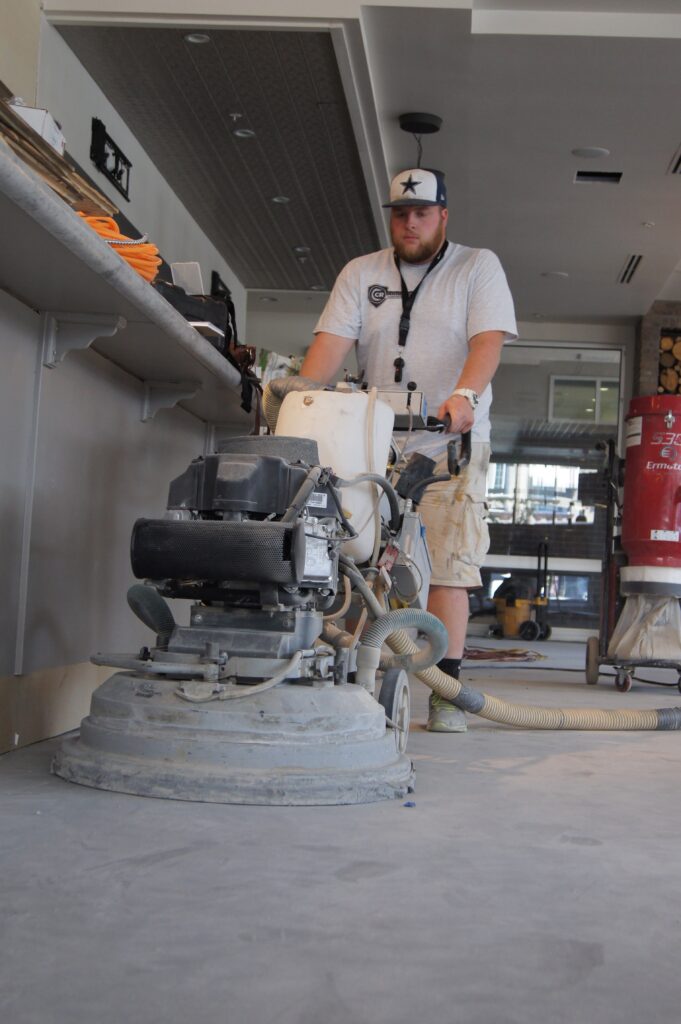
Diamond grinding in progress · our install
Quick answers · this page
What surface profile will I get?
Specified ICRI CSP profiles, matched to what goes on top — profile is the difference between a floor that bonds and one that peels.
Why does prep matter so much?
80–90% of every job is preparation. No coating chemistry compensates for bad prep.
What about silica dust?
Vacuum-shrouded equipment and OSHA-aligned dust control, suitable for occupied facilities.
What does it cost?
Experts scope it on site, then you get a fixed bid — the number on the proposal is the number on the invoice. (Genuinely unknowable scope? Day-rate terms, agreed in writing first.)
Don’t see your question? Call 303-974-6707 — you’ll get a person who’s installed these floors.
Concrete Grinding: When Surface Preparation Determines Outcome
Colorado Concrete Repair performs concrete grinding for profile correction, coating removal, trip-hazard reduction, joint-edge preparation, and substrate preparation across commercial and industrial facilities in the Denver Front Range. Grinding is frequently the first step before any floor coating or polishing system — and the quality of that prep determines how long the finished system performs.
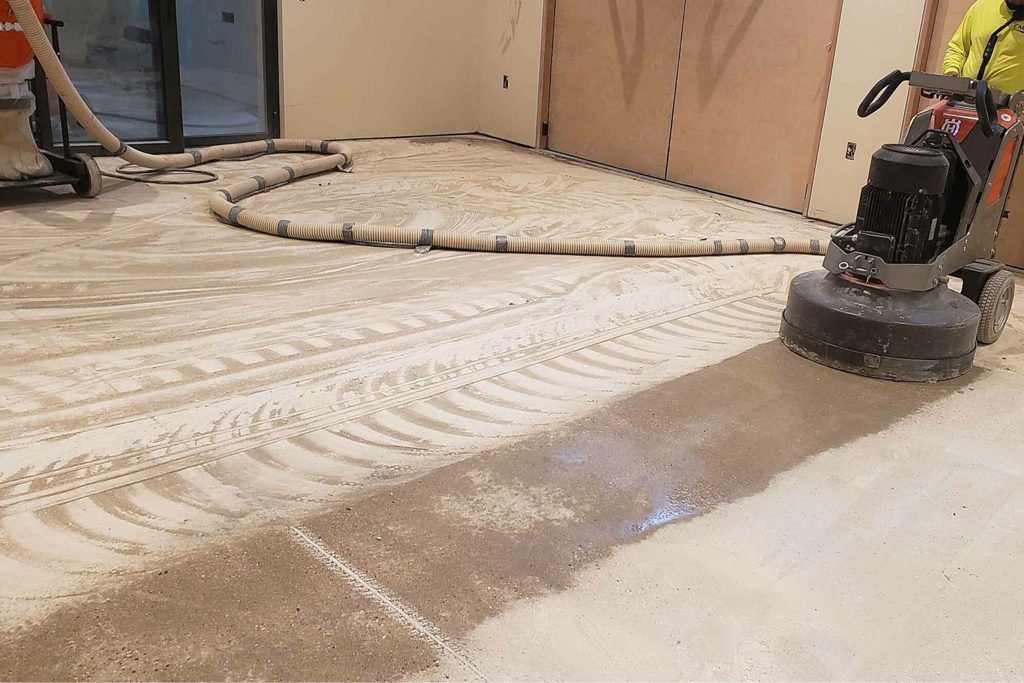
20+ Years
Commercial and industrial flooring experience across the Denver Front Range.
1,000+ Projects
Across coatings, concrete repair, polishing, and specialty flooring systems — matched to each facility’s actual operating conditions.
Scope-Dependent
Project duration depends on facility size, substrate condition, and whether grinding is standalone prep work or part of a larger flooring system installation.
Commercial Concrete Grinding — What to Know Before You Specify
Select a topic to see details, performance factors, and considerations.
When Commercial Concrete Grinding Is the Right SpecificationApplication criteria▼
Best for: Grinding is appropriate when a floor needs profile correction before coating or polishing, when an existing coating needs to be removed, when trip hazards need to be reduced, or when joint edges need preparation before repair. The right grinding method — planetary grinding, shot blasting, or scarification — depends on the substrate condition, the degree of correction needed, and what comes next. CCR evaluates the substrate during the preconstruction site assessment before specifying equipment and approach.
✓ Strengths:
- Matched to your facility’s specific chemical exposure, traffic, and environmental conditions
- Installed by experienced crews with 20+ years of industrial flooring expertise
- Correct surface profile for the coating or polishing system being applied
- Engineered to handle the mechanical loads your facility generates daily
Tradeoffs:
- System selection depends on substrate condition — testing required before specification
- Not every system fits every environment — wrong product selection causes premature failure
- Professional installation required — this is not a DIY or general-contractor operation
Common applications: pre-coating prep, coating removal, trip-hazard correction, joint preparation, and surface leveling across commercial and industrial facilities.
Surface Preparation RequirementsFoundation for performance▼
Best for: Every floor coating, polish, or repair starts with proper surface preparation. 80-90% of our time is spent on surface prep and repairs. CCR recently completed this type of scope at a Aurora commercial facility requiring grind-and-seal and concrete grinding.
✓ Strengths:
- Shot blasting and diamond grinding create the mechanical profile coatings need to bond
- MVER testing identifies moisture vapor issues before they cause delamination
- Crack and joint repair addresses structural defects the coating cannot bridge
- Proper preparation extends system lifespan by years compared to shortcuts
Tradeoffs:
- Adds time to the project schedule — but skipping it costs more in premature failure
- Requires specialized equipment and trained operators
- Substrate condition may reveal issues that change the system specification
Common applications: all commercial flooring projects — see our installation process.
CCR’s Installation ApproachProcess & scheduling▼
Best for: Facilities that need flooring work completed on schedule, within budget, and without disrupting operations. CCR uses zone-phased installation to keep facilities operational during the work. CCR recently completed this type of scope at a south metro commercial facility requiring grind-and-seal, ESD-rated sealer, and concrete grinding.
✓ Strengths:
- Zone-phased installation keeps your facility operational during the project
- Fixed-bid pricing with no surprise change orders from inadequate preconstruction
- 20+ years of experience anticipating and solving on-site challenges
- Post-installation maintenance guidance specific to your system and facility
Tradeoffs:
- Phased installation may extend total project timeline compared to full-facility shutdown
- Preconstruction assessment takes time — but prevents costly mid-project changes
- Quality installation requires adequate cure time between coats — cannot be rushed
Common applications: all CCR flooring projects — request a site assessment.
COMMERCIAL CONCRETE GRINDING QUESTIONS
Concrete Grinding — Common Questions for Denver Facility Teams
What should I know before specifying concrete grinding?
Start with the substrate: condition, moisture levels, structural integrity, and existing coatings all affect what systems will perform. Then factor in your facility’s chemical exposure, traffic type, temperature range, and operational schedule. CCR evaluates all of these during the preconstruction site assessment — the specification follows the facility’s actual conditions, not a generic product recommendation. For example, a Boulder County commercial facility required grind-and-seal — a common scope for this question.
How does surface preparation relate to concrete grinding?
80-90% of our time is spent on surface prep and repairs. Shot blasting and diamond grinding create the mechanical profile that coatings need to bond. Moisture vapor testing identifies moisture drive that causes delamination. Crack repair and substrate leveling address structural defects the floor system cannot bridge. Skipping or shortcutting preparation is the most common reason floor systems fail prematurely. For example, a west Denver metro commercial facility required grind-and-seal — a common scope for this question.
How long does a ground concrete surface hold up?
A properly ground concrete surface holds its mechanical profile for as long as the facility’s traffic demands — the substrate does not wear back unless it takes physical damage. The real lifespan question is how long the coating or polishing system applied over the ground surface will last, which depends on product selection, surface prep quality, traffic intensity, and maintenance. CCR specifies the full system — prep through finish — based on your facility’s actual conditions.
Can this work be done while our facility stays operational?
In most cases, yes. Zone-phased installation keeps portions of your facility operational while other sections are being installed or cured. CCR develops a phased schedule during preconstruction that maps the work to your operational calendar. The tradeoff is a longer total project timeline, but your business keeps running.
What should I look for in a concrete grinding contractor?
Look for a contractor who specializes in commercial and industrial surface preparation — not a general contractor who treats grinding as a commodity service. Ask about their equipment, substrate testing process, and how they determine the correct surface profile for your application. A qualified contractor will evaluate your floor before recommending an approach.
Concrete Grinding Services for Denver, CO Commercial Facilities
Colorado Concrete Repair provides concrete grinding services across Denver, CO and the Front Range for facilities that need precise concrete surface preparation before coating, polished concrete finishing, or slab remediation. Whether the concrete floor needs profile for an epoxy system or the concrete slab has high spots, lippage, or coating failures, our grinding services start with a substrate evaluation to determine the right tooling and approach.
Concrete grinding is often the cost effective first step before any resinous flooring installation. Removing existing sealers, thin coatings, or surface contamination from a concrete floor exposes clean aggregate and creates the mechanical bond profile that high-performance systems require. For polished concrete applications, diamond grinding progresses through successively finer grits to produce a durable, light-reflective concrete surface that eliminates dusting and reduces long-term maintenance costs. On deteriorated concrete slabs across the Front Range, grinding removes spalled material and trip hazards without full-depth removal, making it the cost effective option for facilities that need to stay operational during repairs.
The Proof Behind the Floor — And What We Show When
When you are responsible for an industrial or commercial floor, “trust us” is not proof. Here is what Colorado Concrete Repair can put behind a recommendation today — and how we share the rest.
What we can show right now
- More than 1,000 completed industrial flooring projects.
- Over 20 years of work across Colorado’s Front Range.
- Associated General Contractors (AGC) membership.
- Manufacturer-backed system options — including Dur-A-Flex, Sherwin-Williams, Metzger McGuire, and Resinwerks — selected to match your conditions, not a one-size-fits-all product.
- A prep-first record: surface preparation, crack repair, joint filling, slab leveling, substrate work, and moisture diagnosis come before any finished system goes down.
The project facts and surface conditions we document before recommending a system
A floor recommendation is only as good as what we measure first. During a site assessment we document the conditions that decide which system is right and how long it lasts:
- Slab condition, cracks, joints, and existing surface profile.
- Moisture in the slab — diagnosed, not assumed.
- Contamination and prior-coating history.
- Traffic type and load (including forklift and equipment traffic).
- Chemical exposure, washdown, and cleaning process.
- Thermal conditions and temperature swing.
- Your shutdown window and return-to-service needs.
We do not claim every unknown condition can be eliminated. We claim we find the conditions that matter before we write the scope — so the recommendation holds.
References, photos, and matched project examples — released on request
Named references, project photos, and matched case examples are real, and we share them with qualified buyers on request and matched to your facility type during the assessment, with the project owner’s permission. We do not post client names, logos, or photos we have not been cleared to publish — the same discretion we will extend to your project.
The next step is a site assessment, where we document your conditions and show you the proof that matches them.
What We Can Put Behind a Recommendation
A floor recommendation is only as good as what gets measured first. Before any system goes down, we document the slab, moisture, contamination, traffic, chemistry, thermal swing, and your shutdown window. Named references, project photos, and matched examples are released to qualified buyers on request during the assessment. See what CCR can show and what we document on our site assessment page.
Request a Concrete Grinding Assessment in Denver, CO
Tell us about your facility. We’ll evaluate your substrate, chemical exposure, traffic, and operating conditions — then recommend the system that fits.
Why Colorado Concrete Repair
Floors under J.M. Smucker · Green Chef · Dessert Holdings · Izzio Bakery · Denver Beer Co. · Leiters Health
Reviewed June 12, 2026 · Nick Ferguson, owner — industrial flooring contractor, Denver, since 2009