
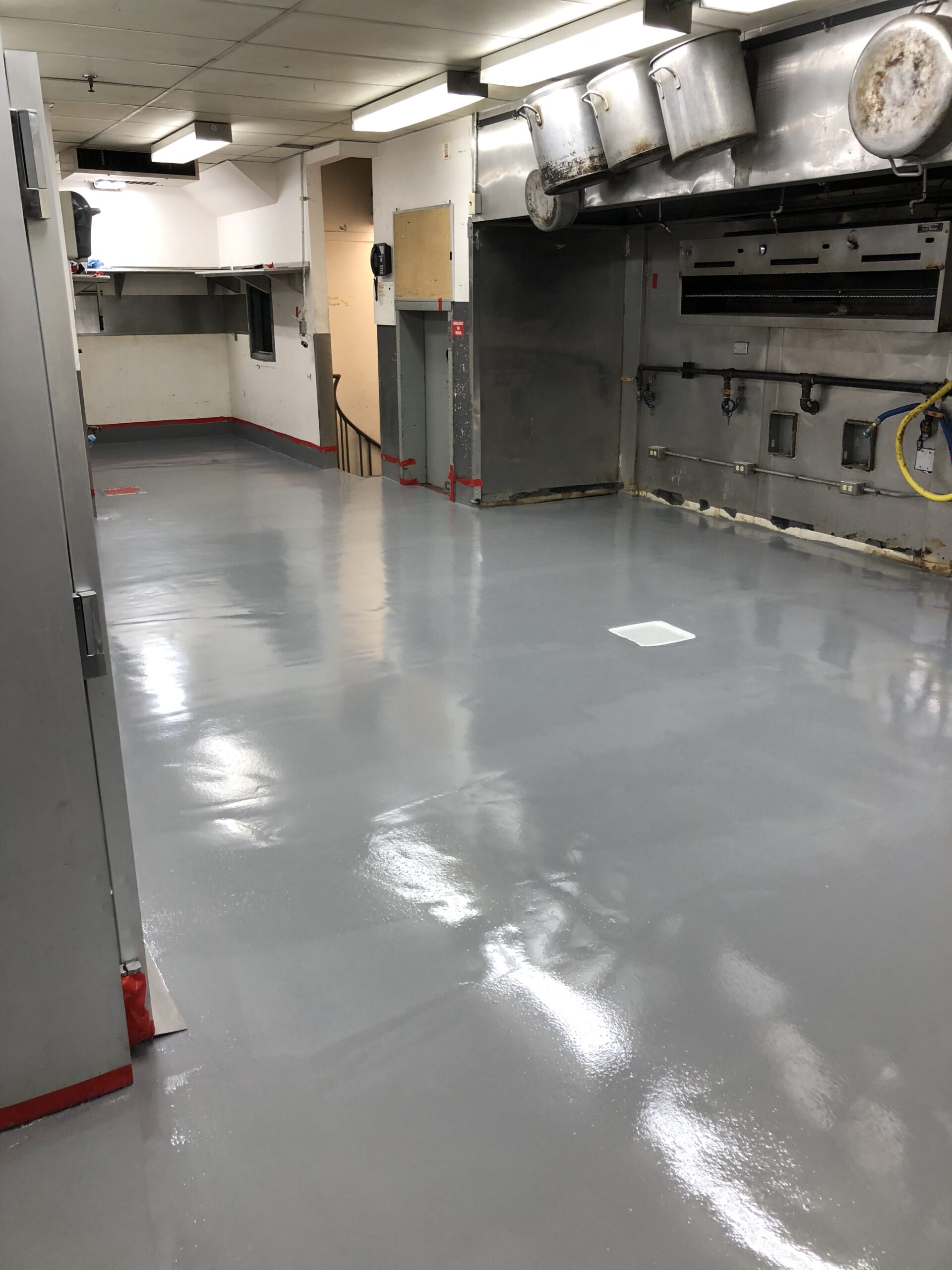
Food Processing Flooring Denver
Urethane Cement, Epoxy & Antimicrobial Systems for Food Processing, Packaging & Distribution Facilities
Colorado Concrete Repair engineers and installs flooring systems for food processing environments across the Denver Front Range — from wash-down production lines and packaging areas to cold-storage transition zones. We scope around sanitation, cleanability, chemical exposure, thermal shock, and maintenance-window execution so facility teams can plan the work before it disrupts production.
Urethane cement is typically the best fit for wet production, hot wash-down, and harsh cleaning cycles. Adjacent dry packaging, warehouse, and support areas may route to other systems when traffic, moisture, and cleaning demands support it.
Facilities with temperature-controlled zones can also review our cold storage flooring page; for seamless floor-to-wall transitions, see our urethane cement and cove base systems pages.
OR, TELL US ABOUT YOUR PROJECT:
USDA/FDA Compliant
Seamless, non-porous flooring systems specified for food-contact environments — chemical resistant, antimicrobial-compatible, and audit-ready.
1,000+ Projects
Completed across Denver food processing plants, packaging facilities, distribution environments, and temperature-controlled production areas.
80–90%
80–90% of our time is spent on surface prep and repairs
FREQUENTLY ASKED QUESTIONS
Food Processing Flooring — Common Questions for Facility Managers
What flooring system is best for a food processing facility with regular wash-down?
Urethane cement is the standard specification for food processing floors exposed to regular wash-down, aggressive chemical cleaning, and thermal cycling. It bonds to damp substrates, resists CIP chemicals, and returns to service quickly — critical for facilities that can’t afford extended downtime. High-build epoxy is an option for dry packaging areas with moderate chemical exposure, but urethane cement is the baseline for wet production zones.
What causes food processing floor coatings to fail?
The most common failures are delamination from moisture vapor, chemical attack from cleaning agents, and thermal shock from hot water wash-down on cool slabs. All three are preventable. Moisture vapor transmission rate (MVER) testing before installation identifies vapor drive issues. Proper system selection accounts for chemical exposure. And surface preparation — shot blasting and profiling — creates the mechanical bond that holds the system under stress. Most failures trace back to prep shortcuts, not product defects.
Can you install flooring without shutting down the entire facility?
Yes. Zone-phased installation is specifically designed for facilities that must stay operational. We section off one production area, install and cure, then move to the next. Urethane cement’s rapid cure makes this practical — sections can return to service within hours. We coordinate installation windows with your production, receiving, and shipping schedules to minimize operational disruption.
Do we need antimicrobial flooring for our food processing plant?
Antimicrobial additives are available and appropriate for certain environments, but the primary defense is a seamless, non-porous surface with proper cove base integration. Antimicrobial additives complement that foundation — they don’t replace it. We specify antimicrobial systems where facility protocols or audit requirements call for it, and document the specification for your food safety records.
How do you handle floor drains and cove base transitions?
Floor drains and cove base transitions are the most audit-critical details in a food processing floor. We integrate cove base to eliminate the floor-to-wall joint that regulators flag, slope floors to drains where required, and seal drain transitions to prevent harborage points. These details are addressed during preconstruction scoping, not discovered mid-install.
Food Processing Flooring Systems Compared
Select a system to see installation details, performance strengths, and tradeoffs.
Urethane Cement — Production GradeWet production & wash-down▼
Best for: Production areas with regular wash-down, aggressive CIP chemicals, and thermal cycling from hot-water cleaning.
✓ Strengths:
- Resists thermal shock, CIP chemicals, and moisture vapor
- Returns to service in hours — minimal production disruption
- FDA/USDA compliant formulations with cove base integration
- Self-sloping capable for drainage zones
Tradeoffs:
- Highest material cost of food processing systems
- Requires PPE due to off-gassing during install
- Short working window demands experienced crews
Urethane Cement — Moderate DutyPackaging & staging▼
Best for: Packaging areas, staging zones, and moderate-traffic areas with periodic cleaning but limited thermal cycling.
✓ Strengths:
- Excellent chemical and impact resistance
- Handles moisture vapor transmission effectively
- FDA/USDA compliant; integrates with cove base
- Faster cure than high-build epoxy
Tradeoffs:
- Not designed for continuous heavy wash-down
- Requires proper substrate preparation
- Premium cost over standard epoxy
High-Build EpoxyDry packaging & corridors▼
Best for: Dry packaging areas, receiving corridors, and zones with moderate chemical exposure but limited moisture or thermal stress.
✓ Strengths:
- Strong chemical resistance for dry production areas
- Cost-effective for above-grade, dry environments
- Seamless non-porous surface; wide finish options
Tradeoffs:
- Not suitable for wet production or heavy wash-down
- Prone to delamination under moisture vapor
- Becomes brittle under thermal cycling
Polished ConcreteDry corridors & admin▼
Best for: Dry receiving corridors, administrative areas, and non-traffic zones adjacent to production.
✓ Strengths:
- No coating layer to peel, bubble, or reapply
- Lowest long-term maintenance cost
- Dust-free finish with densifier treatment
Tradeoffs:
- Not appropriate for wet, chemical-exposed, or high-traffic production areas
- Requires clean, sound substrate
- Limited chemical resistance vs. coated systems
Concrete Repair & ResurfacingScope-based · Substrate repair▼
Best for: Cracked, spalled, or deteriorated slabs needing structural repair before a flooring system is applied — or as a standalone service to restore slab integrity.
✓ Strengths:
- Crack injection & routing, spall filling, joint repair
- Moisture vapor mitigation and substrate leveling
- Required first step for any system with compromised concrete
Tradeoffs:
- Scope and cost confirmed during preconstruction site assessment
- Not a standalone surface finish — typically precedes a coating system
- Timeline depends on extent of damage and slab conditions
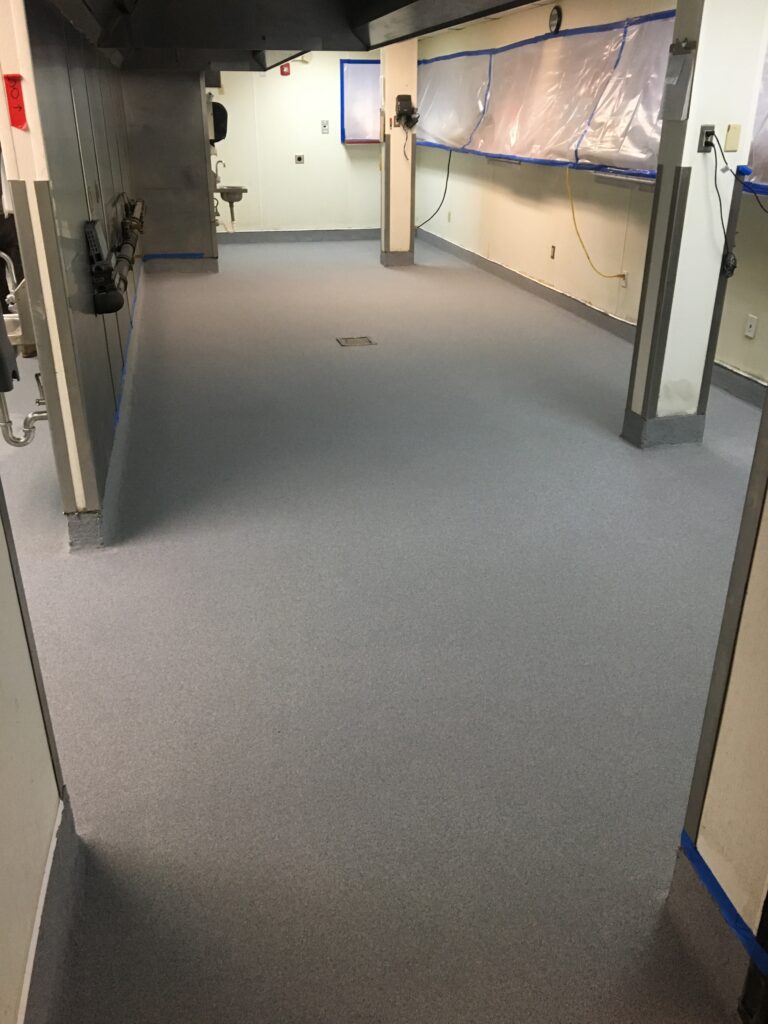
How Our Food Processing Flooring Process Works
A practical process focused on planning, installation, and clean handoff.
STEP 01
Cooperative Planning
We review site conditions with your team, discuss schedule and operating constraints, and compare suitable system options. The goal is to align scope, phasing, and expectations before work begins.
STEP 02
Install the Chosen System
After scope approval, we execute the selected system and prep approach for the area and use case. Work is sequenced to match operational needs and project constraints defined during planning.
STEP 03
Handoff and Next Steps
We complete a final walkthrough with your team, confirm installed scope, and share practical care guidance. Any remaining punch-list items are documented and closed through the agreed handoff process.
FREQUENTLY ASKED QUESTIONS
More Questions About Food Processing Floor Coatings
Operational and project planning answers from our engineering team.
How long does installation take, and how much production downtime should we plan for?
Timeline depends on facility size, zone count, and system selection. Urethane cement in production zones returns to service in hours per section — meaning you can install during a maintenance window and resume operations the same shift. Epoxy sections require longer cure windows and are typically scheduled on weekends, overnight, or during planned shutdowns. We build a zone-by-zone install schedule before work begins so your operations team can plan around every phase.
Can you work inside an active food processing facility that cannot be fully shut down?
Yes. Zone-phased installation is specifically designed for facilities that must stay operational. We section off one area, install and cure, then move to the next. We coordinate installation windows with your production, sanitation, and shipping schedules to minimize disruption to operations and maintain food safety protocols throughout.
What about USDA, FDA, or FSMA compliance for our flooring?
Urethane cement formulations are available in USDA/FDA-compliant versions suitable for food-contact environments. We specify systems from manufacturers who provide compliance documentation with their technical data sheets. Cove base integration eliminates the floor-to-wall joint that regulators flag, and we can provide project documentation for your food safety audits. If your facility is SQF, BRC, or FSMA-regulated, we understand those requirements and spec accordingly.
Our current floors are failing under chemical cleaning. Can they be saved?
Most chemically damaged floors can be repaired and recoated rather than replaced, but the failure mode must be diagnosed first. If the substrate is sound, we remove the failed coating, address moisture vapor or bonding issues, and install a system rated for your actual chemical exposure. If the substrate is compromised, we repair it before coating. We diagnose the failure before recommending a system — not after.
We had a previous coating fail. How do we know the next one will hold?
Most food processing coating failures trace back to the same causes: wrong system for the chemical/thermal exposure, inadequate surface prep, insufficient moisture vapor control, or skipped cove base at wall transitions. We diagnose the failure mode before recommending a system — and we specify based on your actual operating conditions, not defaults. Our 1,000+ completed projects include facility rescues where we replaced failed systems installed by others.
Why Food Processing Operators Choose Colorado Concrete Repair
- Locally owned and operated in Denver CO since 2009
- System specified for your chemical and thermal exposure — urethane cement for wash-down production, urethane cement for packaging, epoxy for dry staging. We don’t apply the same solution to every facility.
- Moisture vapor control built into scope — moisture vapor testing during preconstruction when slab conditions indicate it. High vapor drive is addressed at the substrate level, not covered up.
- 80-90% of our time is spent on surface prep and repairs — Shot blasting, diamond grinding, substrate repair, and cove base integration. The coating is the last step, not the only step.
- Zone-phased scheduling around your operations — We build the install sequence around your production, sanitation, and shipping windows to protect food safety protocols.
- 1,000+ completed industrial projects — Including food processing plants, packaging facilities, distribution environments, and regulated production facilities across Colorado.
- Polyaspartic routing by environment — We specify polyaspartic where the environment and requirements support it, usually as a topcoat rather than a default basecoat in wet food-processing environments.
- USDA · FDA · SQF · BRC · FSMA compliant systems available — We specify and document to your food safety audit requirements.
Colorado Concrete Repair
Projects Completed
1,000+
Industry Association
AGC Member
Prep & Repair Time
80–90%
Food Processing Systems
Urethane Cement · UCM · Epoxy
Compliance
USDA · FDA · SQF · BRC
Request a Food Processing Flooring Assessment in Denver, CO
Colorado Concrete Repair delivers high-performance industrial flooring for food processing facilities, packaging operations, and beverage production plants across Denver, CO and the Front Range. Our flooring solutions are specified for the conditions that define food production environments: thermal shock from hot washdowns, high-traffic forklift lanes, chemical-resistant surfaces rated for caustic cleaning agents, and slip-resistant floor coatings that meet USDA and FDA compliance requirements.
Our food processing flooring systems include urethane cement, epoxy flooring, polished concrete, and chemical-resistant floor coating systems. Each system is selected based on the specific demands of the food processing facility: moisture vapor emission rates, temperature cycling, foot traffic and forklift loading, and the type of chemical exposure the slab will face over its service life. We do not apply generic floor coatings and hope they hold. We specify the right system from manufacturer data and validated installation protocols.
If your facility needs a high-quality flooring system built for food-safe, high-traffic environments, contact us to schedule a site assessment. We will evaluate your slab, operations, and downtime constraints, then recommend the right system for your food processing facility.
OR, TELL US ABOUT YOUR PROJECT:
What Does “Compliant Flooring” Actually Mean in a Food Plant?
FDA’s Current Good Manufacturing Practice rules (21 CFR Part 117) require floors in food facilities to be smooth, hard, impervious to liquid, and cleanable — with no cracks, open joints, or standing water. USDA-inspected meat, poultry, and egg facilities add their own sanitation requirements under FSIS, and GFSI audit schemes like SQF and BRC check the floor as part of every certification audit. No agency “pre-approves” a flooring brand: compliance is a property of the installed system — the right material, correctly sloped to drain, with sealed joints and coved transitions — verified during your audit. That is what we build.
Flooring That Passes Food-Safety Audits
When an SQF or BRC auditor walks your plant, the floor is on the checklist: cracks and spalls that can harbor bacteria, failed joint fill, ponding water from bad slope, coatings peeling in washdown zones. We install and repair the systems auditors expect to see in Colorado food facilities:
- Urethane cement for thermal-shock zones — washdown bays, cook lines, freezer thresholds — where hot-water sanitation cycles destroy ordinary epoxy.
- Food-grade epoxy systems for production, packaging, and traffic aisles.
- Joint repair and crack repair that closes the gaps auditors flag.
- Slope and drainage correction so wash water reaches the drain instead of pooling.
We work nights, weekends, and shutdown windows, and we put the scope, photos, and timeline in writing before any work starts — so your audit-prep schedule holds.
Why Thermal Shock Destroys Ordinary Floors
Thermal shock is rapid temperature swing at the floor surface — a 180°F washdown hitting a 40°F processing-room slab, or a freezer door cycling against a warm corridor. Ordinary epoxy expands and contracts faster than the concrete under it, and the bond shears: cracking, delamination, peeling at the thresholds. Cementitious urethane (urethane cement) moves with the concrete instead of fighting it, which is why it is the standard answer for washdown areas, cook zones, and freezer transitions in food plants. It can be installed in cold rooms and cures at temperatures as low as −20°F.
More Questions From Food-Plant Managers
What flooring do USDA-inspected facilities require?
USDA FSIS doesn’t name a brand or product. It requires floors that are durable, impervious, cleanable, and maintained in good repair — no cracks, no standing water, no surfaces that can harbor bacteria. In practice that means seamless resinous systems (urethane cement or food-grade epoxy) with sealed joints, coved wall transitions, and slope to drain. We install all of these in USDA- and FDA-regulated Colorado facilities.
Will my floor pass an SQF audit?
Auditors look for cracks, failed joints, ponding water, delaminating coatings, and surfaces that can’t be sanitized. If your floor has any of these, fix them before the audit window — repairs are faster and cheaper than findings. We do pre-audit floor assessments for Colorado food facilities: we walk the plant, document the failure points, and put the repair scope and timeline in writing.
Can floor work happen without stopping production?
In most plants, yes. We stage work around sanitation windows, changeovers, weekends, and shutdown nights, zone by zone. Urethane cement systems return to service quickly, and cold-room work doesn’t require warming the room.
What’s the difference between food-grade epoxy and urethane cement?
Epoxy is the workhorse for dry production, packaging, and traffic areas — hard, cleanable, chemical-resistant. Urethane cement is the thermal-shock system — washdown zones, cook lines, freezers — where heat-cycling and hot-water sanitation would destroy epoxy. Most food plants need both, in different zones, and the audit checklist doesn’t care which brand — it cares that the floor is seamless, sloped, and intact.
Get your floor audit-ready. Call 303-974-6707 for an on-site floor assessment, or Request a Site Assessment and we’ll walk your plant before your audit window.
Why Colorado Concrete Repair
Floors under J.M. Smucker · Green Chef · Dessert Holdings · Izzio Bakery · Denver Beer Co. · Leiters Health
Reviewed June 12, 2026 · Nick Ferguson, owner — industrial flooring contractor, Denver, since 2009