
Reviewed June 12, 2026 · Nick Ferguson, owner — industrial flooring contractor, Denver, since 2009
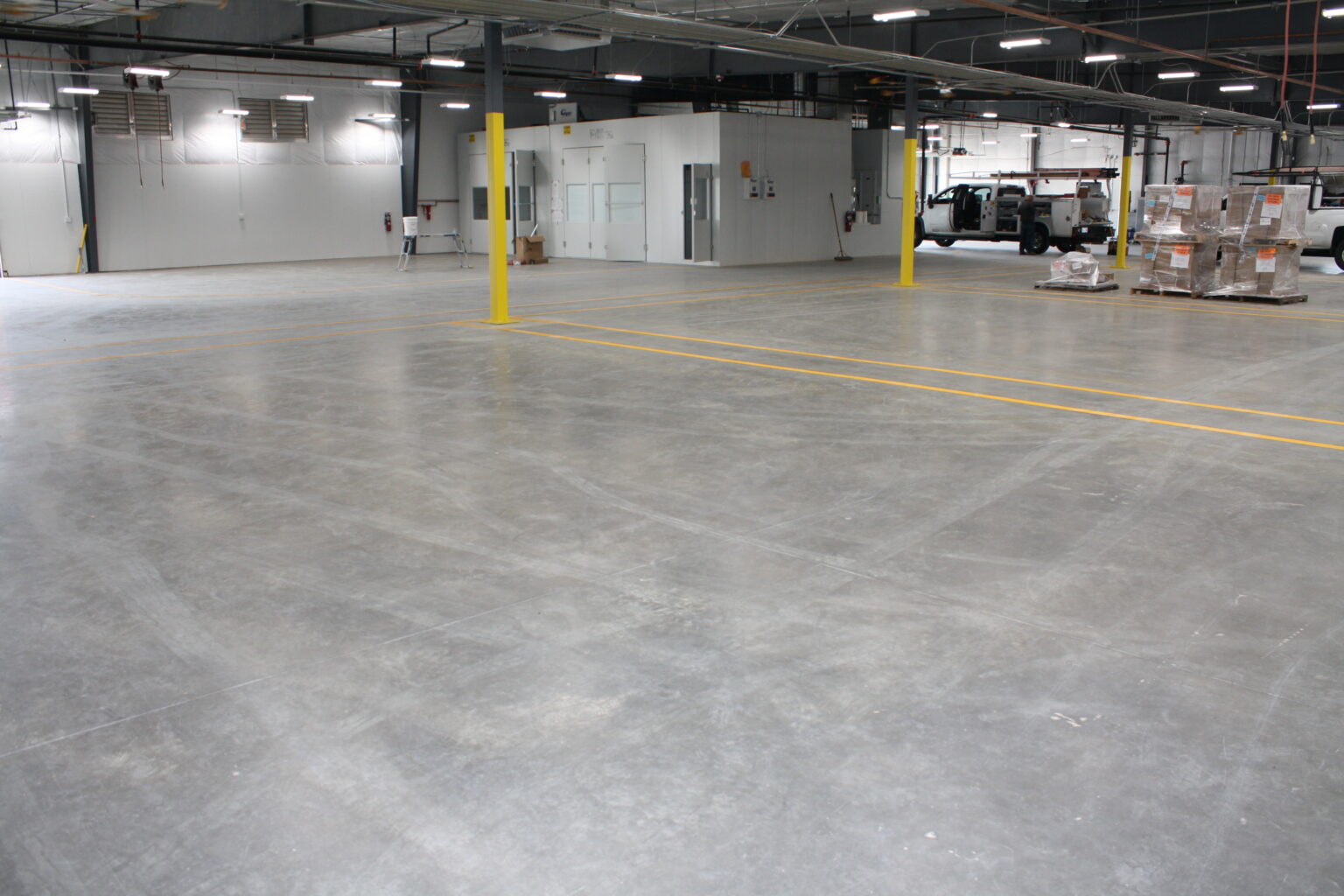
Line striping for working industrial floors in Denver
Forklift aisles, pedestrian lanes, hatched zones and 5S areas, installed on a prepared floor.
Worn lines or a changed layout leave forklifts and people sharing the same floor space. Colorado Concrete Repair installs line striping on industrial and commercial floors across Denver and the Front Range. We prepare the line path first, then tape the layout and apply an epoxy or polyaspartic line coating. The floor condition, the coating under the lines and your access window decide the scope. See our page on polished concrete.
OR, TELL US ABOUT YOUR PROJECT:
Prepared, not painted over
Our striping scopes start with shot blasting or grinding along the line path.
Part of the floor system
Lines can go in on their own, with repairs, with a walkway coating or inside a full floor project. See our page on sealed concrete.
Industrial and commercial floors
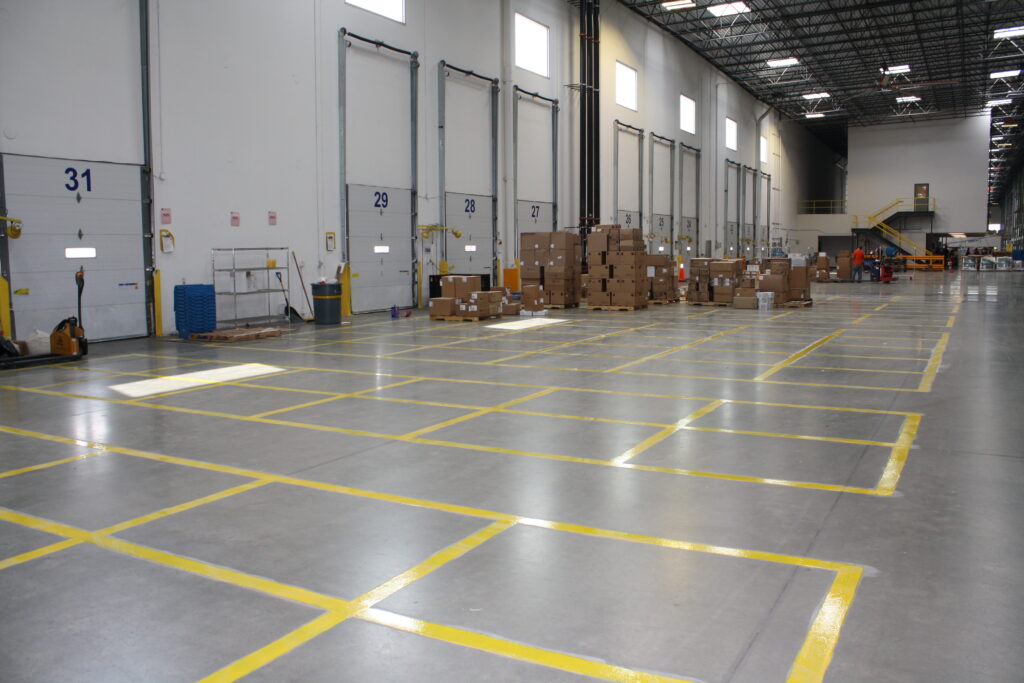
Warehouses, manufacturing plants, food facilities and maintenance bays.
WHY FACILITY MARKING MATTERS
Where line striping fits
01
When floors get restriped
A layout change, new equipment or worn markings are the usual reasons. Recent proposals covered pedestrian lanes, a hatched forklift aisle, a solid walkway and four 5S areas.
02
Marked aisles where forklifts run
OSHA’s materials handling rule says permanent aisles and passageways shall be appropriately marked where mechanical handling equipment is used. Your safety team sets the layout, widths and colors. Lines on the floor do not establish compliance on their own.
03
What we stripe, and what comes first
We stripe interior concrete floors and coated floors. Failing coatings, cracks and spalled edges along the line path can be repaired or removed first, as their own items in the scope.
Common reasons owners call us
- Forklift and pedestrian routes overlap
- Existing lines are fading on epoxy or polished concrete
- Facility has changed layout after equipment moves
- Dock lanes and staging zones need to be redefined
- Safety managers want clearer hazard communication
- New coating installation needs final striping scope
Markings in our recent striping scopes
We design markings around workflow, equipment movement, and floor system performance—not generic templates.
Pedestrian lanesWarehouse · manufacturing▼
Single lines about 4 inches wide, set to your legend.
Hatched forklift aisles and safety zonesSafety separation▼
Hatch areas about 8 inches wide.
Solid color walkwaysOperations control▼
A full coating over the walkway, with a textured second coat.
5S designation areasCaution · danger zones▼
Marked areas with a label, laid out as your staff direct.
Restriping existing linesDock flow▼
New coating along the old line pattern; one proposal covered about 1,100 linear feet.
Old line and number removalWhen part of broader scope▼
Grinding with HEPA filter vacuums attached.
A recent striping scope
The right striping material depends on substrate, expected traffic, cleaning exposure, and whether the marking is being installed as a permanent part of the flooring system or as a shorter-term operational layout.
The request
A warehouse and manufacturing facility in Brighton asked for safety designations in October 2026.
The lines
The proposal covered about 627 feet of single-line pedestrian lanes and a hatched forklift aisle of about 522 square feet. The line scope: shot blast, vacuum, tape, Kinetic 85.
The walkway
A solid green walkway of about 390 square feet: diamond grind, patch cracks and spalls, vacuum, two coats with a textured second coat. This is the scope we proposed and the customer accepted. It is not a before and after.
Line coatings compared
| System | Where we quoted it | Conditions from the maker’s sheet | Tradeoffs |
|---|---|---|---|
| ArmorSeal 8100 water-based epoxy | Pedestrian paths and hatched zones, two January 2026 proposals | Sheet revised January 30, 2026. Clean, dry, sound floor. Apply at 50°F to 100°F, humidity 85 percent or less. At 77°F and 50 percent humidity: recoat after 6 hours, foot traffic 18 hours, heavy traffic 48 hours. | Drying time depends on temperature, humidity and film thickness. |
| Kinetic 85 polyaspartic | Lane lines, hatch areas and a solid walkway, October 2026 | Shot blast or grind to ICRI CSP 2 to 3. Apply at 30°F to 90°F, humidity 85 percent or less. | At 72°F and 50 percent humidity: recoat after 2 hours, foot traffic 3 to 5 hours, heavy traffic 12 hours. |
| Kinetic 85, textured second coat | Solid green walkway, October 2026 | Same sheet. | The second coat carries a grit texture. |
| Restripe along existing lines | About 1,100 linear feet in a September 2026 proposal, with a polished floor | Abrade along the old lines first. | Two coats at 3 to 4 inches wide. |
The two line coatings, and why we prepare the path
Sherwin-Williams describes ArmorSeal 8100 as a water-based epoxy floor coating for industrial and commercial floors. We quoted it in safety yellow for pedestrian paths and hatched zones. Resinwerks describes Kinetic 85 as an 85 percent solids polyaspartic for use as a primer, mid coat or topcoat. We quoted it for lane lines, hatch areas, a solid walkway and restriping. One proposal specified a safety yellow topcoat with an aluminum oxide additive for wear and traction.
Related page — urethane cement
Both makers call for a clean, dry, sound floor. Resinwerks lists a CSP 2 to 3 profile by shot blasting or grinding and says not to apply over coatings that have not been abraded and cleaned. Sherwin-Williams says smooth, hard or glossy coatings should be dulled by abrading before ArmorSeal 8100 goes on.
Typical prep before striping
- Confirm substrate condition and existing coating adhesion
- Clean oils, dust, tire residue, and contaminants
- Our striping scopes shot blast or grind along the line path before tape goes down, with a HEPA filter vacuum on the machine.
- Coatings that are peeling come off before new lines go down.
- Lay out markings to match actual operational flow
- One proposal paired a polished floor with restriped lines, abraded along the old pattern first.
How the lines go in
STEP 01
Prepare the line path
Shot blast or grind the line path with a blast pattern no larger than 8 inches, connected to a HEPA filter vacuum. Vacuum the work area clean.
STEP 02
Tape the layout
A line taping machine sets the tape to your legend, width and layout. Recent proposals used lanes about 4 inches wide and hatch areas about 8 inches wide.
STEP 03
Apply and cure
Apply the line coating to the maker’s instructions with rollers or a line striping machine. Let it cure before traffic returns. Foot and vehicle release times come from the product sheet and the room conditions.
Access and phasing
Tell us which areas can close and when traffic must return. One October 2026 proposal priced the work for off hours and weekends. Another priced up to three phases of work in one mobilization. Quoted durations ran from one day for four 5S areas to about three days for 900 feet of pedestrian path and seven hatched zones.
We don’t promise a floor that stays open through the work. Plan the closure with us before the date is set. Related guide — ADA compliant commercial flooring
Return to traffic
Work days and cure time are separate numbers. The scope sets the days; the product and the room set the cure. At 77°F and 50 percent humidity, Sherwin-Williams lists 18 hours to foot traffic and 48 hours to heavy traffic for ArmorSeal 8100. Resinwerks lists 3 to 5 hours and 12 hours for Kinetic 85 at 72°F. Colder rooms stretch those times. Sherwin-Williams lists 36 hours to foot traffic at 50°F.
FREQUENTLY ASKED QUESTIONS
Line striping questions from facility managers
Technical answers for facility managers, operations teams, and project stakeholders.
What is the process for restriping a warehouse floor?
Abrade along the old lines, vacuum, then apply two coats along the pattern. One proposal covered about 1,100 linear feet this way. Removing old lines is a separate grinding scope.
Can you stripe over an existing epoxy floor?
Yes, when the coating is sound. Both makers say to abrade and clean an existing coating first. A coating that is peeling comes off before new lines go down.
What colors should warehouse floor markings be?
Your safety team’s legend decides. Our proposals follow the striping legend attached to the proposal. Recent ones used safety yellow and green.
Do line widths matter?
The layout sets them. Recent proposals used lanes about 4 inches wide, hatch areas about 8 inches wide and restriped lines at 3 to 4 inches.
Who offers concrete floor striping for warehouses?
We do, for warehouses, plants and maintenance bays across Denver and the Front Range. Striping can be its own scope or part of a floor coating or repair project.
Will worn or peeling floor lines affect an audit?
That is your auditor’s call. Food plants raise this question before audits, and the two fixes are removal or restriping. One proposal for a food facility marked four 5S areas with a freezer-ready label in a one-day scope.
What a CCR striping proposal includes
Preparation named in the scope
Shot blast or grind along the line path, with the blast pattern width and the vacuum written in.
Your legend, your layout
We follow the striping legend attached to the proposal and the pattern your staff mark out.
1,000+ completed projects. Proud member of Associated General Contractors (AGC).
The product, by name
Our line coating proposals name the product, such as ArmorSeal 8100 or Kinetic 85.
Repairs as separate items
Cracks, spalls and joints along a walkway get their own line in the scope.
Access terms
Off hours, weekends and the number of phases are priced where you need them.
Set up a site visit
Send your layout and the areas you can close. We’ll look at the floor, the old lines and the coating under them, then write the scope. Recent striping proposals went to facilities in Denver, Aurora, Brighton and Longmont.