
Concrete With Sealer
Sealed Concrete Floors for Offices, Retail, Showrooms & Light-Duty Commercial Space
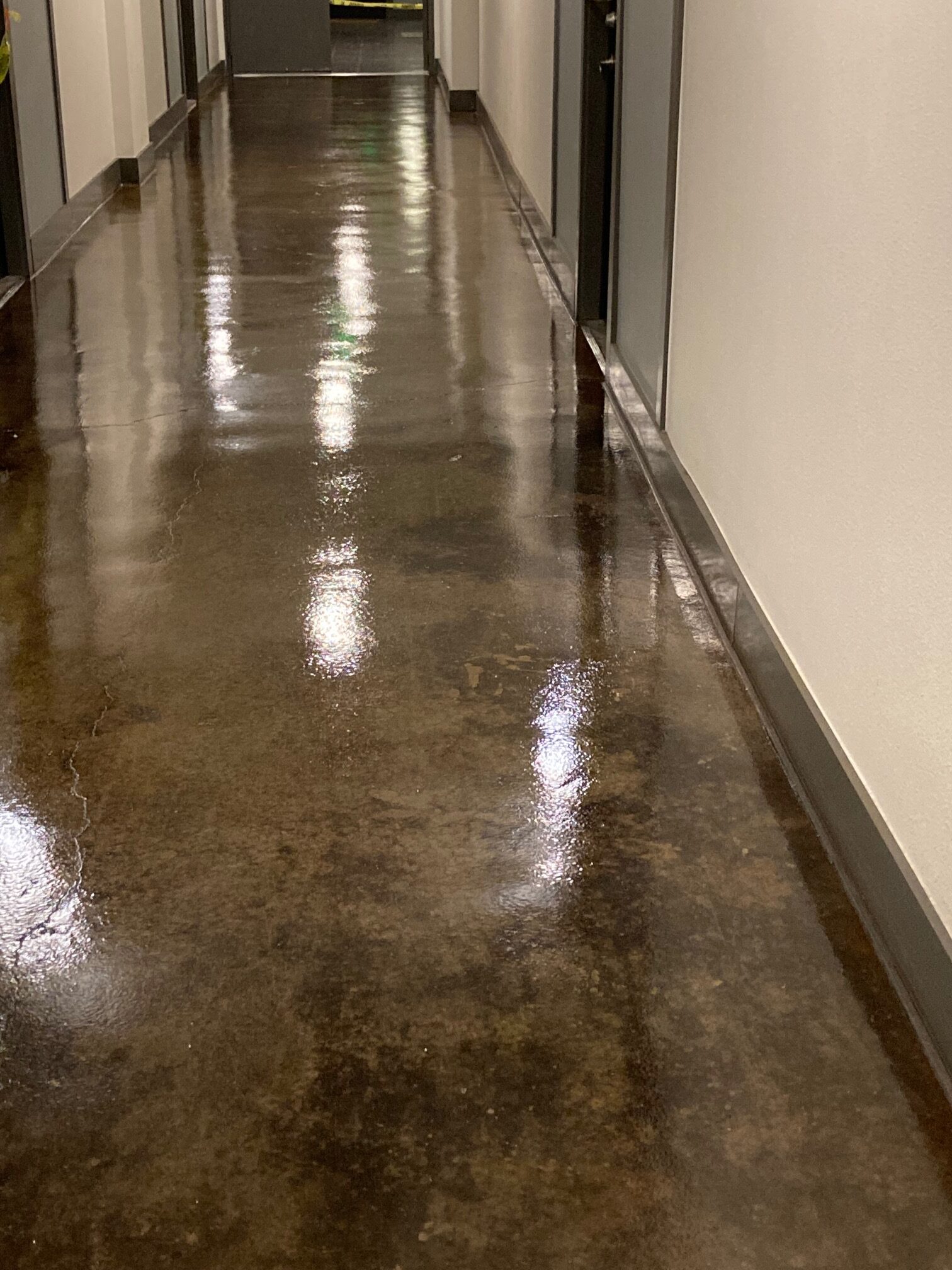
Sealed concrete is the straightforward middle ground between bare slab and a full resinous flooring system. Instead of building a thick coating or grinding to a high-polish finish, the slab is mechanically prepared and treated with a penetrating densifier, acrylic guard, epoxy sealer, or polyaspartic sealer to control dusting, improve cleanability, and upgrade appearance. For offices, retail floors, light industrial spaces, labs, and showrooms, it can be the right specification when you want practical performance without overbuilding the floor.
OR, TELL US ABOUT YOUR PROJECT:
Low-Maintenance Upgrade
A sealed slab keeps the floor simple: fewer layers, lower build, and easier future touch-up than most decorative coating systems.
Best for Light Duty
Ideal for offices, retail, lobbies, educational space, clean warehouses, and commercial interiors that want a finished concrete look.
Prep Still Matters
Even on a simple grind-and-seal project, the slab condition determines performance. Joint repair, patching, and profile are where the job is won or lost.
SEALED CONCRETE EXPLAINED
What Sealed Concrete Actually Means
“Concrete with sealer” is often used loosely in the market, which is why owners get conflicting bids. In practical terms, sealed concrete means an existing or newly placed slab has been cleaned and mechanically prepared, then treated with a protective product rather than covered with tile, carpet, or a heavy resinous broadcast system. The goal is to reduce porosity, minimize dusting, improve stain resistance, and create a more intentional finished surface.
There are two big categories. First are penetrating treatments such as silicate densifiers. These react inside the concrete, harden the surface, and help control dusting without creating a film that can peel. Second are film-forming sealers such as acrylics, thin epoxy sealers, and polyaspartic guards. These sit at or near the top of the slab and create more visible protection, often with a satin or gloss appearance.
That distinction matters. A densified slab still looks and behaves like concrete. A topical sealer can deepen color, add sheen, and improve chemical resistance, but it also creates a maintenance cycle because wear happens at the coating layer. Many owners do not need a full broadcast epoxy system, but they do need more than bare concrete. That is where grind-and-seal or densify-and-guard systems make sense.
CCR sees that middle-ground demand regularly in the field. Space-NG booked a lab room concrete grind and sealer scope, and also selected an ESD concrete sealer breathable flooring solution when conductivity and a simple sealed finish were more relevant than a thick decorative coating. Those are good examples of sealed concrete being specified for function, not for flash.
Typical sealed-concrete scope
- Moisture and surface condition review
- Coating or contaminant removal if needed
- Diamond grinding to open the slab
- Joint, crack, and patch repair where visible defects matter
- Densifier, stain guard, or topical sealer application
- Optional burnish or light sheen enhancement
- Traffic return instructions and maintenance plan
When Sealed Concrete Makes Sense
A sealed floor is not a universal answer. It performs best where you want an upgraded concrete finish, moderate protection, and a sensible budget.
Good fit
- Office buildings that want a cleaner architectural look than raw slab
- Retail, breweries, and showrooms where owners prefer concrete character over a heavy coating build
- Back-of-house commercial areas with foot traffic, carts, and periodic cleaning
- Educational, religious, and civic facilities trying to lower maintenance cost versus VCT or carpet
- Light-duty warehouse or assembly areas where dust control matters more than aggressive chemical resistance
Poor fit
- Food processing washdown environments
- Battery charging, solvent exposure, or chemical splash areas
- Forklift-heavy operations with steel wheels and severe abrasion
- Slabs with constant moisture vapor pressure and no mitigation strategy
- Facilities expecting the floor to hide a rough or patchy substrate
The substrate must also be honest. Because sealed concrete does not hide much, slab quality shows through. A clean architectural finish often requires more joint work and patch refinement than owners expect. That is why CCR brings repair discipline into these jobs. The same company that performs warehouse joint grinding and patching for clients like The Feed on a joint filler, grinding, and patching project can apply that repair-first mindset to a cleaner sealed finish where visual consistency matters.
Sealer Types Compared
These product families do different jobs. The right answer depends on traffic, stain exposure, desired sheen, and how often the owner is willing to maintain the floor.
Penetrating Silicate DensifierLowest-build option▼
Best for: Dust-proofing, hardening, and improving cleanability while keeping the appearance closest to natural concrete.
Advantages:
- No film layer to peel
- Works well under burnished maintenance programs
- Natural look with low lifecycle complexity
Limitations:
- Limited stain resistance by itself
- Will not hide blotchy concrete color
- Not the right answer for chemical or wet process floors
Acrylic Topical SealerDecorative guard▼
Best for: Interior decorative concrete, retail floors, stained concrete, and lower-impact spaces needing a modest sheen.
Advantages:
- Easy to refresh
- Can enrich color and improve appearance quickly
- Lower upfront cost
Limitations:
- More vulnerable to scratching and wear patterns
- Can whiten under moisture or repeated wet mopping if the wrong product is used
- Requires periodic reapplication
Epoxy Sealer / Thin-Film EpoxyBetter chemical resistance▼
Best for: Light commercial areas that need more stain and chemical resistance than acrylic can provide, but not a full broadcast epoxy build.
Advantages:
- Tougher film than acrylic
- Can give a clean, uniform satin-to-gloss finish
- Useful where simple cleanability matters
Limitations:
- Still a topical coating with wear cycle considerations
- Less forgiving of moisture issues
- UV yellowing can be a concern depending on product and exposure
Polyaspartic Sealer / Guard CoatFast return to service▼
Best for: Owners prioritizing rapid cure, UV stability, and a more durable clear top layer over prepared concrete or over an epoxy primer system.
Advantages:
- Fast cure and quick traffic return
- Good gloss retention and UV stability
- Useful as a topcoat when schedule is compressed
Limitations:
- Material cost is higher than acrylic
- Short working time means installer quality matters
- Still not a substitute for a true heavy-duty industrial system in severe service
Sealed Concrete vs. Epoxy vs. Polished Concrete
These three systems are often bid against each other, but they solve different problems.
| Category | Sealed Concrete | Polished Concrete | Epoxy System |
|---|---|---|---|
| Primary goal | Basic protection, dust control, cleaner appearance | Mechanical refinement and long-term low maintenance | Chemical resistance, seamless build, stronger visual transformation |
| Look | Natural to satin/gloss depending on sealer | Refined reflective concrete finish | Uniform coating surface; many color and texture options |
| Build thickness | Very low | None; slab is mechanically processed | Moderate to high depending on system |
| Best traffic level | Light to moderate | Moderate foot traffic and some equipment depending on slab | Moderate to heavy, including industrial use when properly specified |
| Maintenance cycle | Recoat or refresh depends on product and wear | Routine cleaning and periodic burnishing | Topcoat wear and eventual recoat |
| Upfront cost | Low to moderate | Moderate | Moderate to high |
If the owner wants a design-forward finished concrete floor with better reflectivity and no topical wear layer, polished concrete is usually the stronger long-term answer. CCR has delivered polished concrete in two service shops for Boulder Nissan, completed polished concrete and prep for Parker Core Knowledge, and handled refurbishment work for Aramark Facility Services. Those projects illustrate where full polishing earns its keep.
If the owner needs stronger stain, impact, or chemical resistance, epoxy is the more appropriate specification. CCR installed epoxy and urethane systems for manufacturing, data center, pharmaceutical, and warehouse clients including Western Forge, RK Mission Critical, STAQ Pharma, and Protecto Wrap. A sealed floor is usually chosen when those performance demands are lower and the budget or appearance goal points toward a simpler finish.
Maintenance Requirements Owners Should Expect
Sealed concrete is low-maintenance, not no-maintenance. Dust mopping, neutral cleaner, auto-scrubbing with the right pad pressure, and fast cleanup of spills are standard. What changes by product is the refresh cycle.
Penetrating densifier systems may simply need periodic burnishing and disciplined cleaning. Acrylic or thin-film sealers usually need spot repair and eventual recoat in traffic lanes. Polyaspartic and epoxy sealers can stretch the interval, but once abrasion dulls the top layer, owners should plan for a maintenance topcoat before the floor is worn through in walk paths.
That is why the best conversation is not “Which sealer is strongest?” It is “How much maintenance will our team actually do?” If the answer is very little, a mechanically refined slab with densifier may outperform a cheap glossy sealer simply because there is less film to fail.
Practical owner checklist
- Use neutral pH cleaner, not harsh degreasers as a default
- Protect entrances with walk-off mats
- Repair joints before they begin spalling into traffic lanes
- Schedule touch-up before wear becomes exposed concrete damage
- Match maintenance pad and cleaner to the installed sealer type
Cost Comparison: Budget Reality
Pricing depends on slab condition, square footage, patching, moisture issues, and whether the goal is architectural finish or utility finish. The ranges below are planning numbers only.
Basic densify / guard
Often lowest cost
Best when the slab is already fairly clean and the goal is dust-proofing plus a more intentional finish.
Grind and seal with patching
Moderate
Common for commercial interiors where visible defects need correction before sealing.
Polished concrete
Moderate to high
More grinding steps and refinement, but often stronger long-term economics in the right application.
Epoxy / resinous system
Moderate to highest
Higher build and performance, appropriate when the use case justifies it.
Cost conversations also need to include lifecycle. A lower-cost acrylic sealer that needs frequent refresh may not beat a better densified finish over five years. Conversely, trying to save money by choosing sealed concrete where the operation really needs epoxy is a specification mistake, not a savings.
FREQUENTLY ASKED QUESTIONS
Concrete With Sealer — Common Questions
Is sealed concrete the same thing as polished concrete?
No. Polished concrete is a mechanically refined floor created through multiple grinding and polishing steps with densifier chemistry supporting the process. Sealed concrete may involve some grinding, but the performance and appearance come primarily from the sealer treatment rather than a full polishing sequence.
Will a sealer hide cracks, patches, or joint lines?
Usually no. Some clear film products can slightly deepen color and soften contrast, but sealed concrete still reads as concrete. If appearance matters, repair details and patch color matching should be discussed during the site assessment.
Can sealed concrete handle forklifts?
It depends on wheel type, load, traffic frequency, and the slab condition. For light-duty or occasional traffic, some sealed concrete systems are appropriate. For aggressive industrial traffic, a more robust resinous system or a different concrete finish is usually the better choice.
How often does sealed concrete need to be recoated?
That depends on the product family and traffic. Acrylics generally refresh sooner. Higher-performance topcoats last longer. Penetrating densifier systems may not need recoat in the same way, but they still require proper cleaning and occasional maintenance burnishing.
Is sealed concrete slippery?
Slip resistance depends on texture, contaminants, moisture, and the selected finish. A high-gloss topical sealer is not the right choice for every environment. CCR evaluates use conditions and can recommend texture or a different system when traction is critical.
How does CCR decide whether to recommend sealed concrete, polish, or epoxy?
The decision comes down to how the floor is used: traffic, chemicals, moisture, aesthetics, downtime tolerance, and maintenance capacity. We compare the slab condition with the owner’s operating requirements and recommend the least complicated system that still does the job.
Why Owners Call Colorado Concrete Repair for Sealed Concrete Projects
- We understand the difference between a decorative clear sealer, a breathable treatment, and a real industrial flooring system.
- Our work starts with slab evaluation, repair scope, and surface prep — not a one-size-fits-all product pitch.
- CCR handles grinding, leveling, joint repair, polishing, and coatings, so recommendations are based on fit, not on a single product category.
- Field experience ranges from grind-and-seal and ESD sealer work for Space-NG to full polishing projects for Boulder Nissan, Parker Core Knowledge, Revive Church, and Aramark.
- We use the language executives and facility teams need: lifespan, maintenance burden, downtime, and operational fit.
Talk through your floor options
If you are comparing sealed concrete to polish or epoxy, the right answer starts with the slab and the use case. We can review the condition, discuss the maintenance reality, and identify the most sensible system.
OR, TELL US ABOUT YOUR PROJECT: