
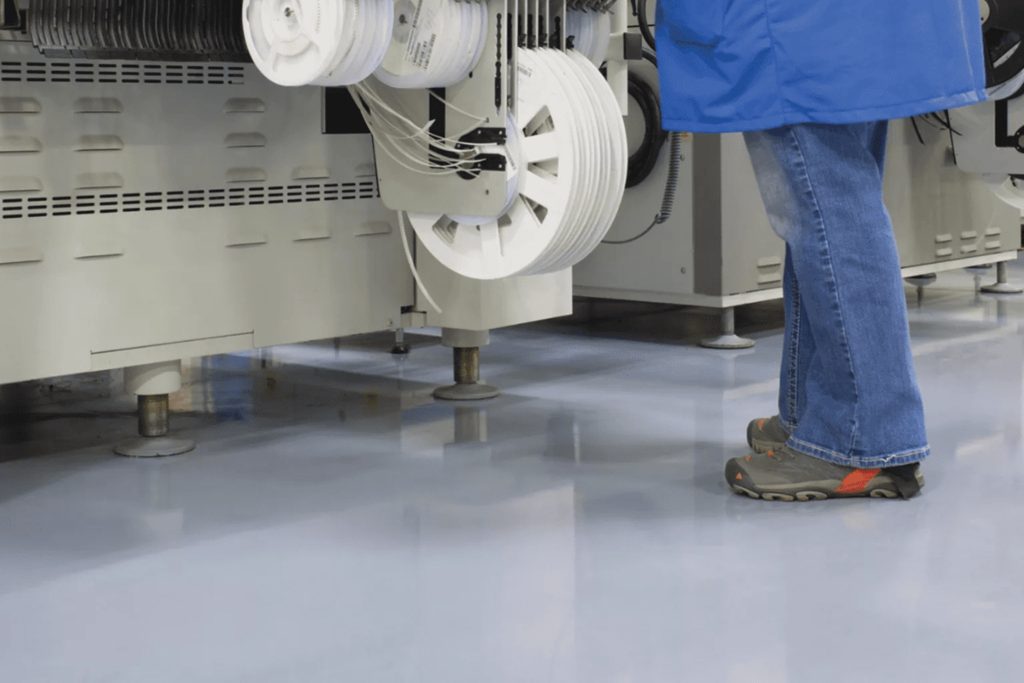
Commercial ESD Flooring
ESD Flooring Denver
Static-Dissipative and Conductive Flooring for Data Centers, Electronics Facilities, and Cleanrooms
Colorado Concrete Repair installs ESD-rated epoxy systems for electronics manufacturing, server rooms, data centers, and cleanroom environments across the Denver Front Range.
OR, TELL US ABOUT YOUR PROJECT:

ESD floor prep, static-sensitive facility · our install
Quick answers · this page
What resistance range does my spec need?
Most aerospace/electronics specs: static-dissipative 10⁶–10⁹ ohms per ANSI/ESD S7.1 inside an S20.20 program. Munitions: conductive 10⁴–10⁶.
Can you test our existing floor?
Yes — point-to-point and point-to-ground readings per S7.1, documented for your program file.
Can you install without stopping the line?
Usually zero production loss. Nights, weekends, and zone-by-zone phasing around your operation.
What does it cost?
Experts scope it on site, then you get a fixed bid — the number on the proposal is the number on the invoice. (Genuinely unknowable scope? Day-rate terms, agreed in writing first.)
Don’t see your question? Call 303-974-6707 — you’ll get a person who’s installed these floors.
ESD Anti-Static Epoxy Flooring: A Practical Guide for Commercial and Technical Facilities
Colorado Concrete Repair installs ESD-rated epoxy systems in data centers, server rooms, and electronics facilities across the Denver Front Range. This guide covers ESD requirements, static dissipation, and the flooring specifications these environments demand.

20+ Years
Commercial and industrial flooring experience across the Denver Front Range.
1,000+ Projects
Across coatings, concrete repair, polishing, and specialty flooring systems — matched to each facility’s actual operating conditions.
~5-Day Installs
Average project duration for this system type — phased around operating schedules.
ESD Flooring Systems — What to Know Before You Specify
Select a topic to see details, performance factors, and considerations.
When ESD Anti-Static Epoxy Flooring Is the Right SpecificationApplication criteria▼
Best for: ESD flooring is appropriate in facilities where electrostatic discharge poses a real operational or safety risk — data centers, server rooms, electronics assembly areas, and similar static-sensitive environments. It is not a universal requirement for every commercial floor. CCR evaluates each facility’s sensitivity requirements during the preconstruction site assessment before specifying an ESD-rated system.
✓ Strengths:
- Matched to your facility’s specific chemical exposure, traffic, and environmental conditions
- Installed by experienced crews with 20+ years of industrial flooring expertise
- Seamless, non-porous finish that simplifies cleaning and maintenance
- Engineered to handle the mechanical loads your facility generates daily
Tradeoffs:
- System selection depends on substrate condition — testing required before specification
- Not every system fits every environment — wrong product selection causes premature failure
- Professional installation required — this is not a DIY or general-contractor operation
Common applications: data centers, server rooms, electronics assembly areas, and other static-sensitive facilities.
Surface Preparation RequirementsFoundation for performance▼
Best for: Every floor coating, polish, or repair starts with proper surface preparation. 80–90% of our time is spent on surface prep and repairs, not the product itself. CCR recently completed this type of scope at a Denver metro commercial facility requiring ESD-rated sealer and polyaspartic topcoat.
✓ Strengths:
- Shot blasting and diamond grinding create the mechanical profile coatings need to bond
- MVER testing identifies moisture vapor issues before they cause delamination
- Crack and joint repair addresses structural defects the coating cannot bridge
- Proper preparation extends system lifespan by years compared to shortcuts
Tradeoffs:
- Adds time to the project schedule — but skipping it costs more in premature failure
- Requires specialized equipment and trained operators
- Substrate condition may reveal issues that change the system specification
Common applications: all commercial flooring projects — see our installation process.
CCR’s Installation ApproachProcess & scheduling▼
Best for: Facilities that need flooring work completed on schedule, within budget, and without disrupting operations. CCR uses zone-phased installation to keep facilities operational during the work. CCR recently completed this type of scope at a south metro manufacturing facility requiring ESD-rated sealer.
✓ Strengths:
- Zone-phased installation keeps your facility operational during the project
- Fixed-bid pricing with no surprise change orders from inadequate preconstruction
- 20+ years of experience anticipating and solving on-site challenges
- Post-installation maintenance guidance specific to your system and facility
Tradeoffs:
- Phased installation may extend total project timeline compared to full-facility shutdown
- Preconstruction assessment takes time — but prevents costly mid-project changes
- Quality installation requires adequate cure time between coats — cannot be rushed
Common applications: all CCR flooring projects — request a site assessment.
ESD Resistance Classifications and Testing Standards
ESD flooring systems are classified by electrical resistance — the property that determines how quickly static charge dissipates through the floor and into the building’s grounding system. Three resistance classifications apply to commercial and industrial ESD flooring:
Conductive flooring: resistance of 25,000 ohms to less than 1 megohm (10³ to <10⁶ ohms). Conductive flooring provides the fastest discharge path and is required in the most static-sensitive environments — powder handling, explosive atmospheres, and facilities with strict ANSI/ESD S20.20 compliance requirements.
Static dissipative flooring: resistance of 1 megohm to 1 gigaohm (10⁶ to 10⁹ ohms). Static dissipative flooring is the more common specification for data centers, electronics assembly, and server rooms. It slows static discharge rather than eliminating it — reducing the risk of fast, damaging discharge events while maintaining personnel safety.
Antistatic flooring: resistance greater than 1 gigaohm. Antistatic materials resist charge generation at the surface rather than providing a controlled discharge path. These are not ESD flooring in the technical sense — they are used in environments where charge generation prevention is the goal rather than grounding. CCR specifies based on your facility’s actual sensitivity requirements, not a generic ESD label.
Resistance testing during and after installation confirms the system meets specification. ANSI/ESD S20.20 and IEC 61340-5-1 are the primary standards governing ESD control programs including flooring requirements. CCR coordinates specification requirements with facility compliance teams during preconstruction.
Grounding Systems and Static Charge Dissipation
An ESD floor system only works when it is properly connected to a building grounding network. The floor coating alone does not eliminate static electricity — it provides the conductive or static dissipative path through which static charge travels from the person or object to ground. Without a completed grounding circuit, even a correctly specified ESD floor system cannot perform its function.
Grounding is achieved through copper grounding strips or grounding points embedded beneath or within the floor system and connected to the building’s grounding bus. The frequency of copper grounding points depends on the floor area size and the required resistance values. Personnel must complete the grounding path — either through ESD footwear, heel grounders, or wrist straps connected to grounded equipment. The floor provides the dissipation path; the grounding system connects that path to earth.
Static charge buildup from personnel walking on standard commercial flooring is a measurable source of ESD risk. Standard vinyl, carpet, and unsealed concrete floors generate and hold static charge that discharges into sensitive electronics on contact. Static dissipative and conductive flooring systems prevent this charge accumulation by continuously dissipating static electricity to ground as personnel move through the facility. CCR evaluates your facility’s charge generation sources and grounding infrastructure during the site assessment to ensure the specified system addresses your actual ESD risk profile.
Surface Resistivity Standards and ESD Floor Coating Alternatives
Surface resistivity and volume resistivity are the two electrical measurements used to characterize ESD flooring performance. Surface resistivity measures resistance across the floor surface (ohms per square). Volume resistivity measures resistance through the floor material (ohm-centimeters). ANSI/ESD S20.20 specifies resistance to ground requirements for ESD control program compliance — typically requiring that installed floors measure no greater than 10¹⁹ ohms resistance to a ground point under controlled test conditions. CCR specifies and installs systems that meet these targets when tested at the ANSI/ESD standard conditions of 12% relative humidity.
Clean room and electronics manufacturing environments often require ESD flooring combined with a static control program that includes personnel grounding, component handling procedures, and ionizer placement at static-sensitive workstations. The floor system is one layer of a complete ESD control program — it provides the passive dissipation path while active measures (wrist straps, ionizers, ESD packaging) address other charge sources. CCR coordinates floor specification with facility ESD program managers to ensure the installed floor system supports the full program’s requirements, not just the floor specification in isolation.
ESD floor tile is an alternative to poured epoxy for some applications. ESD-rated vinyl floor tile or conductive carpet tile can be installed in certain environments as a modular alternative to a continuous epoxy coating. However, tile-based systems introduce grout lines or seams that may not meet cleanroom contamination control requirements, and tiles require individual ground connection for each unit to function as designed. For most commercial and industrial applications — data centers, electronics assembly, pharmaceutical clean rooms — a seamless poured epoxy ESD system provides more reliable, maintainable, and verifiable static control performance than a tile-based alternative. CCR installs poured ESD epoxy systems only; we do not install ESD tile.
Humidity significantly affects ESD flooring performance. At low relative humidity (below 15%), static electricity generation increases dramatically because dry air is a poor conductor. ESD flooring systems maintain their protective dissipation path regardless of humidity levels — unlike anti-static treatments that depend on moisture for conductivity. This makes properly specified static dissipative and conductive flooring essential in Colorado’s dry climate, where humidity routinely drops below ESD-critical thresholds in winter and in climate-controlled facilities. ESD damage to sensitive electronic components can occur at discharge events below the threshold of human perception — making passive ESD floor protection a baseline requirement, not an optional upgrade, in electronics handling environments.
ESD Epoxy and Electrostatic Dissipative Flooring Systems
ESD floors and electrostatic dissipative flooring systems protect sensitive equipment, electronic components, and personnel from static discharge damage. CCR installs ESD epoxy floor systems, anti static flooring, and dissipative floors for data centers, electronics manufacturing, aerospace facilities, defense environments, and laboratories in Denver, CO and across the Colorado Front Range. Every flooring system we install meets or exceeds ANSI ESD S20.20 grounding and resistance requirements.
The difference between an ESD epoxy floor that performs and one that fails is in the grounding system and material selection. ESD floors require a conductive primer layer, copper grounding grid connected to building ground, and a topcoat formulated for the correct resistance range. Dissipative floors typically measure between 1.0 x 10^6 and 1.0 x 10^9 ohms. Conductive ESD floors fall below 1.0 x 10^6 ohms. CCR selects the right electrostatic dissipative or conductive epoxy floor system based on the facility’s electrostatic discharge sensitivity requirements and the static control standards that apply.
ESD flooring installations also require chemical resistance in many industrial flooring environments. Pharmaceutical clean rooms, semiconductor fabrication areas, and defense-related facilities often need ESD floors that resist solvents, cleaning agents, and process chemicals in addition to controlling static electricity and electrostatic discharge. CCR evaluates these combined requirements during the site assessment and specifies the ESD epoxy flooring system that meets both the static control and chemical resistance needs of the space.
If your facility requires ESD floors, anti static flooring, or electrostatic dissipative epoxy flooring in Denver, CO, contact us for a site assessment. We will evaluate the grounding requirements, static discharge sensitivity, and service conditions to recommend the right ESD flooring system for your operation.
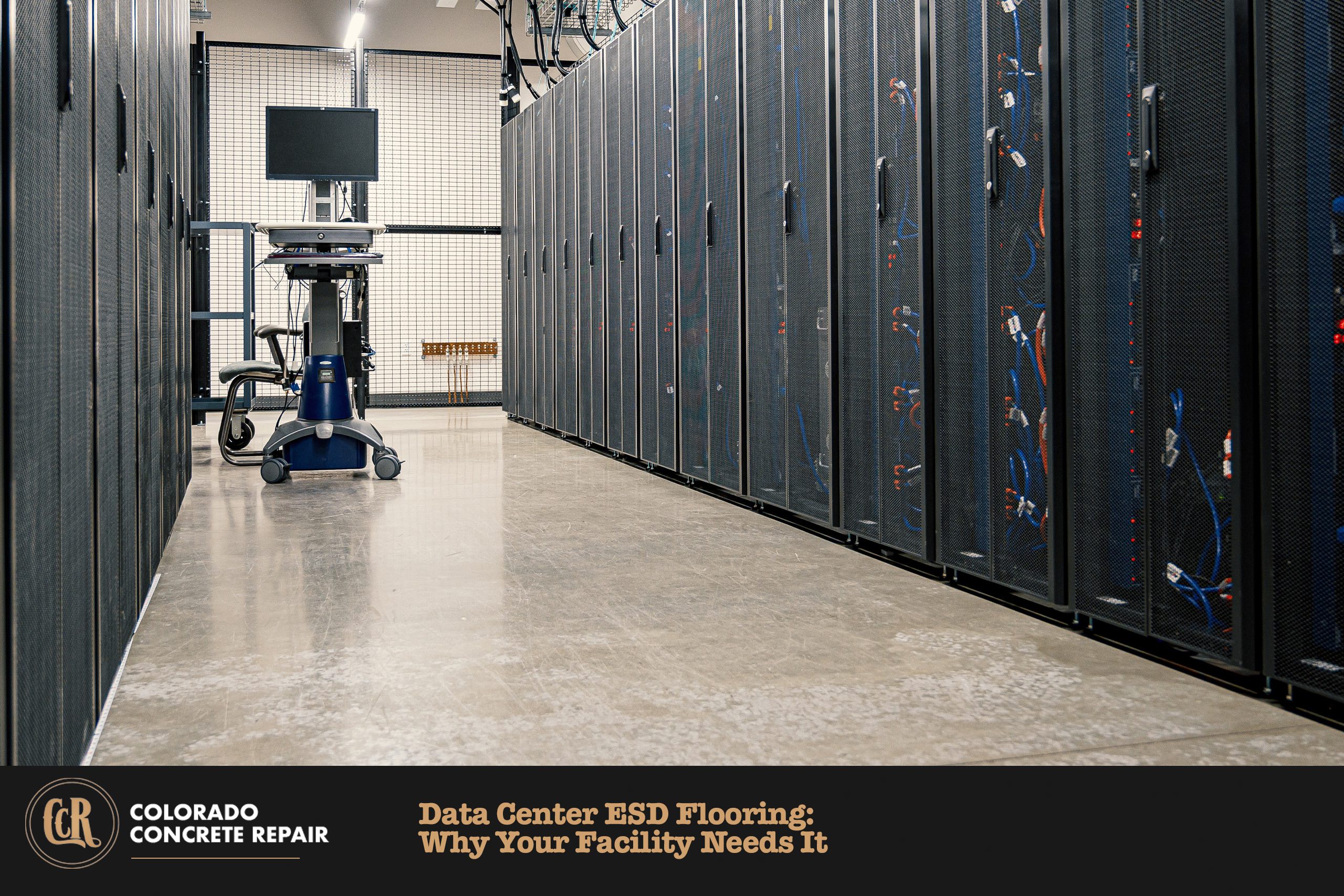
ESD ANTI-STATIC EPOXY FLOORING QUESTIONS
ESD Anti-Static Flooring — Common Questions for Facility Managers
What should I know before specifying ESD flooring?
Start with whether ESD flooring is actually required for your facility’s operations. ESD specifications apply where electrostatic discharge poses a real risk — electronics manufacturing, data centers, server rooms, and similar static-sensitive environments. Not every industrial or commercial floor requires an ESD-rated system. If ESD is warranted, the specification depends on your facility’s sensitivity requirements, the existing substrate condition, moisture levels, and traffic patterns. CCR evaluates all of these during the preconstruction site assessment — the system specification follows your facility’s actual requirements.
How does surface preparation affect ESD floor systems?
80–90% of our time is spent on surface prep and repairs. Shot blasting and diamond grinding create the mechanical profile that coatings need to bond. Moisture vapor testing identifies moisture drive that causes delamination. Crack repair and substrate leveling address structural defects the floor system cannot bridge. Skipping or shortcutting preparation is the most common reason floor systems fail prematurely. For example, a south metro commercial facility required grind-and-seal — a common scope for this question.
How long does an ESD floor system last?
Properly specified and installed systems typically deliver 10–20+ years depending on traffic intensity, chemical exposure, and maintenance practices. The variables that shorten lifespan are the same across all systems: wrong product for the exposure, inadequate surface preparation, and insufficient maintenance. CCR specifies based on your actual operating conditions.
Can this work be done while our facility stays operational?
In most cases, yes. Zone-phased installation keeps portions of your facility operational while other sections are being installed or cured. CCR develops a phased schedule during preconstruction that maps the work to your operational calendar. The tradeoff is a longer total project timeline, but your business keeps running.
What should I look for in an ESD flooring contractor?
Look for a contractor with documented ESD flooring experience — not a general flooring company that treats ESD as a standard coating job. Ask whether they understand the grounding requirements, system performance requirements, and testing expectations your facility needs. A qualified ESD flooring contractor will ask about your facility requirements before recommending a product.
What Your Procurement Process Gets — And How the Decision Moves
Specifying and buying an industrial floor is a documented decision, especially in ESD, controlled, and regulated environments. Before you take a floor through purchasing, a spec, or a GC, here is the documentation Colorado Concrete Repair can put in front of your approval process — and the sequence that produces it. The goal is a clear, written scope before you approve anything, so the project moves on facts, not on a number that changes after award.
A written fixed-bid scope, built from a site assessment. CCR builds the proposal after a preconstruction site assessment, not from a product list. The proposal documents the facility conditions, the system selected by zone, the surface preparation, the schedule, and the scope boundaries. Why it de-risks the decision: the number on the proposal is the number on the invoice. A bid that skips the assessment looks cheaper until unassessed slab, moisture, traffic, or access conditions surface as change orders after award — a written scope identifies them before you sign, not after.
Manufacturer-backed system documentation. CCR works with manufacturer-backed system options and selects the system by zone — slab, traffic, chemistry, thermal conditions, cleaning process, static-control need, and schedule — instead of applying one coating across the whole facility. Why it de-risks the decision: your approval, spec reviewer, or GC sees which system is proposed for which condition and on what manufacturer basis, not a single product name asked to do every job.
Qualification documentation for your file. CCR is an established Front Range industrial contractor with a long project record and AGC membership, and leads with prep-first installation discipline. Why it de-risks the decision: purchasing and GC files want a qualified, documented contractor on the record before a floor goes into a controlled or regulated space. (Named references, project case studies, and photos are released on request during the assessment and proposal stage, matched to a project that fits your facility — they are not posted here.)
A written warranty-and-maintenance scope boundary. The written scope identifies the covered workmanship items, the manufacturer material documentation, the expected operating conditions, and the maintenance assumptions that affect long-term performance — before work begins. Why it de-risks the decision: everyone approving the purchase sees what is in scope, what depends on facility use, and what the maintenance plan assumes, in writing, instead of discovering it later.
How the decision moves — the sequence:
- Site assessment. CCR reviews the slab, moisture, traffic, chemistry, thermal profile, static-control need, shutdown window, and documentation requirements on site.
- Written fixed-bid proposal. The assessment becomes a written scope: facility risk summary, system selection by zone, prep plan, shutdown / return-to-service plan, and a warranty/maintenance scope boundary — a fixed bid, not an open hourly arrangement.
- Your internal approval. You take the written scope through purchasing, the spec, or the GC. Because the scope is written before award, your approval is reviewing a known scope, not an unknown one.
- Scheduled install around your window. Once approved, the work is sequenced around how the facility actually operates — phased zones, weekends, overnights, or a maintenance window — with a defined return-to-service point per zone.
You do not need a finished spec to start the sequence. The site assessment is where the scope gets written.
What Your Approval Process Gets
ESD, data-center, and controlled-environment projects move through a spec, a GC, or a purchasing review before award. CCR’s site assessment becomes a written fixed-bid scope — system selected by zone, prep plan, schedule, and a warranty-and-maintenance scope boundary — so the number on the proposal is the number on the invoice. See what documentation your process gets and how the decision moves on our site assessment page.
Request an ESD Flooring Assessment in Denver, CO
Tell us about your facility. We’ll evaluate your substrate, chemical exposure, traffic, and operating conditions — then recommend the system that fits.
Conductive vs. Static-Dissipative Flooring — Which Does Your Spec Require?
| Property | Conductive (ECF) | Static-Dissipative (SDF) |
|---|---|---|
| Resistance to ground | 2.5×10⁴ – 1.0×10⁶ ohms | 1.0×10⁶ – 1.0×10⁹ ohms |
| Charge bleed speed | Fastest | Controlled |
| Typical use | Munitions, explosives-adjacent, highest-sensitivity electronics | Electronics manufacturing, aerospace assembly, data halls, cleanrooms |
| Spec language to look for | “ECF per ANSI/ESD S20.20 program” | “SDF, system resistance verified per ANSI/ESD S7.1” |
Your ESD program document — not the flooring vendor — defines which range your facility needs. We install both, and we verify the installed floor’s resistance to ground before handover.
How ESD Floors Are Tested and Verified
- ANSI/ESD S20.20 — the program standard your auditors certify against; the floor is one element of the program.
- ANSI/ESD S7.1 — resistance characterization of the installed floor (point-to-point and point-to-ground).
- ANSI/ESD STM97.1 / STM97.2 — the person-plus-footwear-plus-floor system tests: walking-body voltage and system resistance.
- IEC 61340-5-1 — the international counterpart many aerospace primes reference.
We test the installed system and document the readings, so your ESD coordinator has verification data for the program file — not just a material data sheet.
ESD Flooring for Aerospace and Defense Facilities
Aerospace assembly, avionics labs, and defense electronics areas typically spec static-dissipative epoxy or urethane systems verified to the ranges above. We install ESD floors in Colorado aerospace and defense facilities — see our aerospace and defense flooring page for clearance-friendly scheduling, phased installs around production, and the systems primes most often spec. ESD-safe systems are also core to our data center flooring work.
ESD Verification Questions
What resistance range does an aerospace ESD floor need?
Most aerospace and electronics specs call for static-dissipative flooring in the 10⁶–10⁹ ohm range verified per ANSI/ESD S7.1, inside an S20.20 program. Munitions and explosive environments often require conductive flooring (10⁴–10⁶). Your ESD program document governs — bring it to the site assessment and we’ll match the system.
Does ESD flooring need special maintenance?
Yes — the wrong floor finish or cleaner can insulate the surface and silently break the dissipative path. We hand over a maintenance sheet with approved cleaning practices, and we can re-test resistance after deep cleans or repairs.
Can you verify our existing floor still meets spec?
Yes. We measure resistance to ground and point-to-point per ANSI/ESD S7.1 and give you the readings. If the floor fails, we’ll tell you whether the fix is a topcoat, a ground-path repair, or a new system — in writing.
Call 303-974-6707 for an on-site floor assessment, or Request a Site Assessment.
Why Colorado Concrete Repair
Floors under J.M. Smucker · Green Chef · Dessert Holdings · Izzio Bakery · Denver Beer Co. · Leiters Health
Reviewed June 12, 2026 · Nick Ferguson, owner — industrial flooring contractor, Denver, since 2009