Food Processing Facility Flooring Requirements: What You Need to Know
Food Processing Facility Flooring Requirements: What You Need to Know
Colorado Concrete Repair installs urethane cement flooring and other resin floors from our Denver base. This guide covers what a food plant floor has to handle and what inspectors and auditors look at.

Since 2009
Commercial and industrial floors, from our Denver base.
Over 1,000 Jobs
We’ve done more than 1,000 jobs, company-wide.
HEPA Vacuums
Our food plant quotes list grinders and shavers with HEPA filter vacuums attached.
Food Facility Flooring — What to Know Before You Specify
Select a topic to see details, performance factors, and considerations.
Urethane Cement or Epoxy in a Food PlantWhich room gets what▼
Best for: Food processing rooms and wash areas. Two makers we install list urethane cement there. Resinwerks lists BIO-CEM MF for food and beverage manufacturing and breweries. Sherwin-Williams lists Poly-Crete MD for food processing areas, bakeries, and sanitize and wash areas.
What our food plant quotes list:
- A 1/4 in urethane cement slurry with a 40 grit silica sand broadcast
- A troweled epoxy and sand cant cove around the room
- A novolac epoxy topcoat with an antimicrobial additive
- Polyaspartic taken up the concrete stem at the wall in a food processing warehouse
Limits:
- The maker’s data sheet sets each product’s temperature and chemical ratings
- Cure time depends on the product and the room conditions
- A damp slab can need a moisture mitigation system, which our terms treat as a change order
Common applications: commercial and industrial facilities — see our food-grade flooring page.
What Inspectors and Auditors Look AtCracks, seams, drains▼
Best for: Food plants that face USDA FSIS inspections or SQF audits. Food Safety Magazine reports that FSIS weekly checks look for “cracked floors” among the signs of sanitation problems.
What gets written up:
- Food Engineering reported FSIS citing “cracks, holes and broken flooring that could hold moisture”
- On one SQF thread: “Pitted concrete floors are not acceptable, but an epoxy surface without cracks is okay.”
- Another poster there: “I think the bigger issue for SQF is seams.”
- A food safety manager reported mopping standing water every 4 hours because the floor isn’t sloped to the drain
Limits:
- A cove or a slip texture is a scope item. It is not an audit result.
- One food plant suspected that cleaning chemicals and water had weakened its coating’s bond
- Our cooler quotes list a sloping repair as a separate option
Common applications: food processing rooms and wash areas — see our urethane cement systems.
Surface Preparation RequirementsFoundation for performance▼
Best for: Surface preparation is 80-90 percent of the time we spend on a job. Our food plant quotes spell out the prep steps.
What our quotes list:
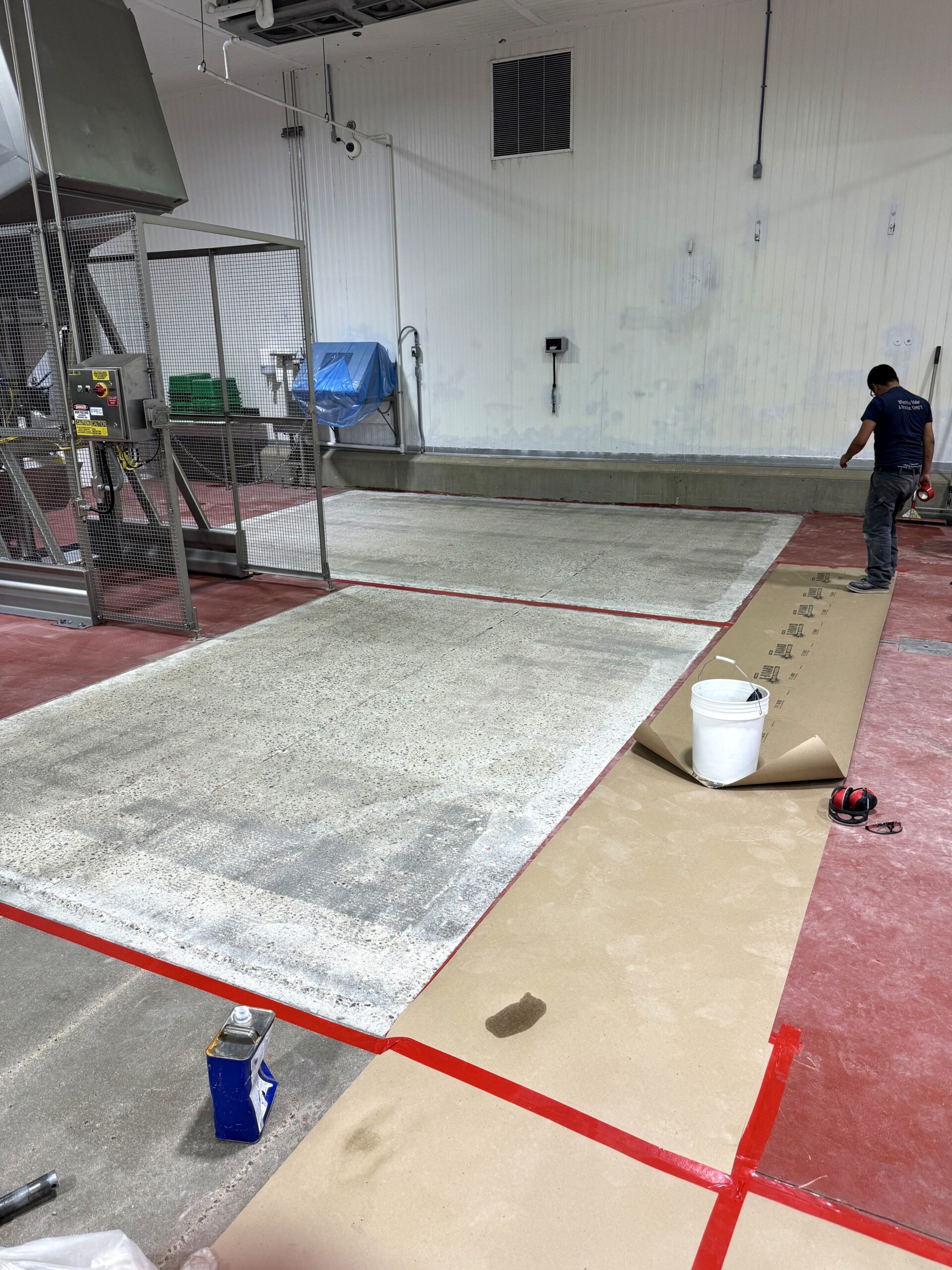
- Grind or media blast until the concrete reaches a CSP of 2 or greater
- Grinders and blasters attached to industrial HEPA filter vacuums
- Cracks, spalls and joints filled and ground flush where they occur, unless joints are to be honored
- Patchwork filled with a thickened vapor barrier epoxy
Limits:
- Steps vary by floor, and each quote lists the steps for that floor
- Removing an old coating can be quoted as time and materials by the day
- On one bakery quote, grinding after the shavers stops once the shaver lines are removed
Common applications: all commercial flooring projects — see our installation process.
CCR’s Installation ApproachProcess & scheduling▼
Best for: Plants that can’t shut down every room at once. Access, phasing and off-hours work can be part of the quoted plan.
What can be part of the plan:
- Work split into phases, as on a bakery quote with up to two phases
- Work during a planned shutdown
- Off-hours work
- Samples approved before the project starts, for color, texture, slip resistance and cleanability
Limits:
- Cure time depends on the product, so access and cure conditions are agreed for each job
- The maker’s data sheet sets cure times for foot traffic, vehicle traffic and chemical service
- Some work is quoted as time and materials
Common applications: all CCR flooring projects — request a site assessment.
FOOD PROCESSING FACILITY FLOORING REQUIREMENTS QUESTIONS
Frequently Asked Questions About Food Processing Facility Flooring Requirements
What does a food plant floor have to handle?
Washdown, cleaning chemicals and water at the drains. Food Engineering reported that USDA FSIS inspectors cited cracks, holes and broken flooring that could hold moisture. Makers we install list urethane cement for food processing and wash areas. Each product’s data sheet sets its temperature and chemical ratings, so your cleaning chemicals and temperatures pick the system.
How do you prep a food plant floor?
Surface preparation is 80-90 percent of the time we spend on a job. Our food plant quotes list grinding or media blasting to a CSP of 2 or greater on HEPA filter vacuums. They list cracks, spalls and joints filled and ground flush where they occur, unless joints are to be honored. A damp slab can add a mitigation system.
Why do food plant floors fail?
Plant staff put it plainly. One food plant guessed that cleaning chemicals and water had weakened the coating’s bond to the concrete. A plant manager told Food Engineering that when you wash a floor, stuff gets sucked in under it. Cracks, seams and water standing at drains come up in inspections and audits.
Can this work be done while our facility stays operational?
It depends on the rooms and the product’s cure time. Access, phasing and off-hours work can be part of the quoted plan. Our food plant quotes have included work in up to two phases and a bakery renovation during a planned shutdown. Access and cure conditions are agreed for each job.
How do I choose the right contractor for food processing facility flooring requirements?
Look for industrial flooring specialization — not a general contractor who subcontracts flooring. Ask about surface preparation methods, substrate testing, and system specification process. Ask for references from facilities similar to yours. A qualified contractor will ask detailed questions about your facility before recommending a product — not push a single system for every application.
Request a Site Assessment
Tell us about your facility. We’ll evaluate your substrate, chemical exposure, traffic, and operating conditions — then recommend the system that fits.