
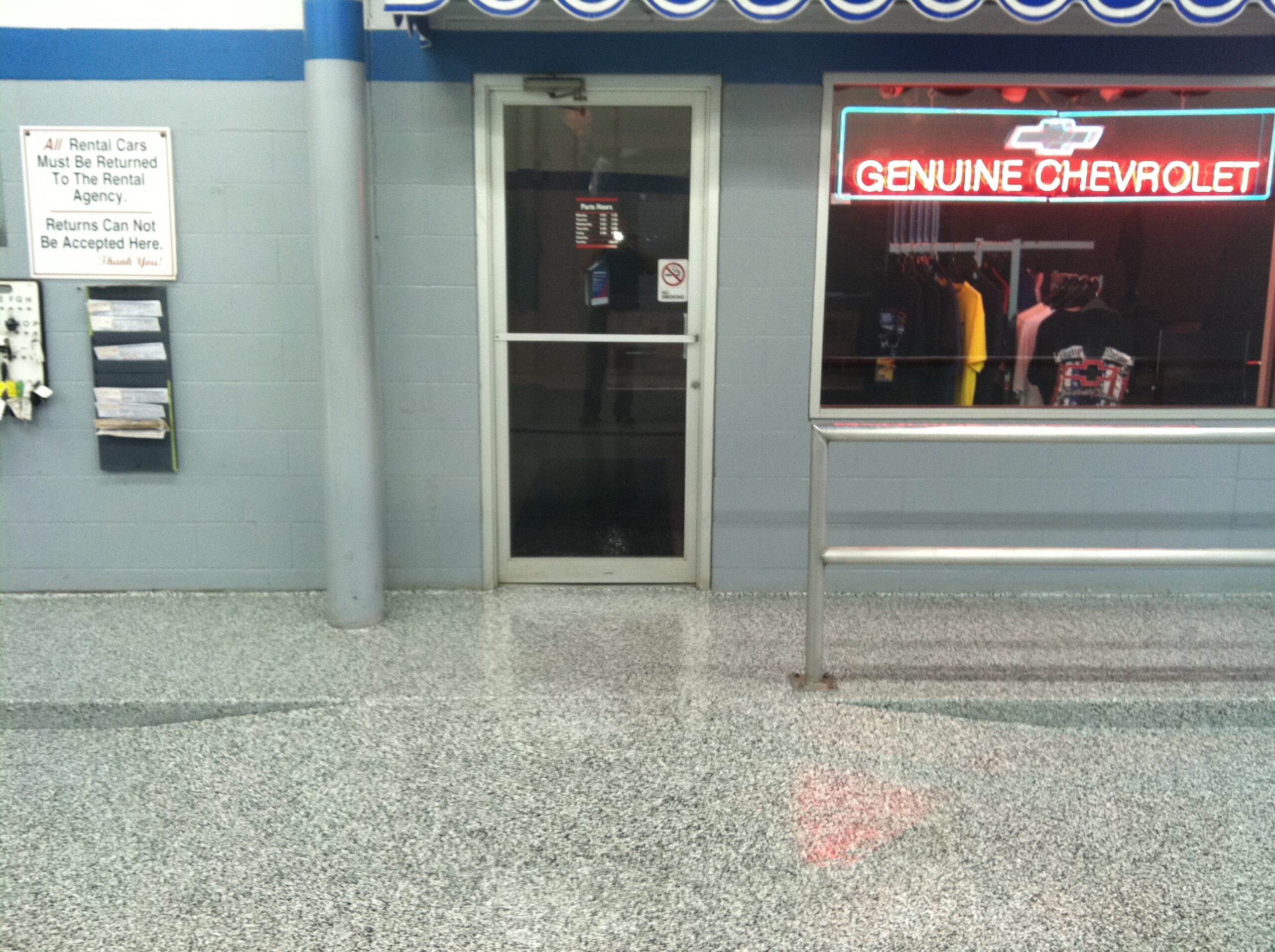
Polished Concrete Floors Denver
Commercial Concrete Polishing, Dyed Finishes & Grind-and-Seal Alternatives for Colorado Facilities
Colorado Concrete Repair installs polished concrete floors for commercial and industrial facilities across the Denver Front Range. Our Jobber history includes 79 polished concrete jobs across automotive service departments, schools, churches, offices, industrial buildings, restaurants, grocery interiors, hangars, metal buildings, and workshop spaces — plus 215 grind-and-seal jobs that help owners compare the right finish for the slab they actually have. We handle coating removal, joint and repair prep, densification, multi-step diamond polishing, dyed polished concrete, refurbishment work, and HEPA-managed grinding for occupied commercial environments.
This matters because polished concrete is not a universal answer. A dry dealership shop, school commons, church gathering area, grocery interior, office refurbishment, or aviation support space may be a strong polishing candidate. A slab with heavy repair history, chronic moisture issues, frequent grease contamination, or a need for stronger chemical resistance may point toward grind and seal or another flooring system instead. CCR approaches that decision from the standpoint of service conditions, not trend language.
OR, SHARE YOUR PROJECT DETAILS:
79+ Polish Projects
Real polished concrete job history across commercial and industrial interiors including dealership shops, schools, churches, offices, hangars, utility rooms, restaurants, grocery spaces, and industrial support areas.
215+ Grind & Seal
CCR’s largest related concrete-finish category by count, giving owners a practical side-by-side comparison between true polishing and grinding plus clear sealer protection.
Prep
Actual industrial line-item evidence of how surface prep drives the project: CSP-2 preparation, heavy epoxy removal, diamond grinding, Ermator vacuums, HEPA filtration, cleaning, and final cleanup.
FREQUENTLY ASKED QUESTIONS
Polished Concrete — Common Questions
Polished concrete is usually attractive to commercial buyers for the same reasons: the slab becomes the finish, routine maintenance can be simpler than a coating cycle, and the floor can look clean and professional without layering another product over the concrete. But those advantages only hold when the slab is worth refining and the environment actually fits exposed concrete. A facility that needs chemical containment, frequent washdown cleaning, or a more uniform cosmetic result may need another path.
CCR’s project history is useful because it covers both sides of that decision. The company has polished service-shop areas, schools, churches, offices, industrial support spaces, restaurants, grocery interiors, hangars, and utility environments, while also completing far more grind-and-seal jobs overall. That mix helps keep the recommendation grounded in field reality instead of selling every owner the same finish language.
What is polished concrete, and how is it different from a coating?
Polished concrete is a mechanical refinement of the slab itself. The floor is cut, repaired, densified, honed, and polished with diamond tooling until the concrete becomes the finished wear surface. Epoxy, polyaspartic, and urethane systems are different because they place a resin layer over prepared concrete rather than turning the slab itself into the floor.
When is polished concrete a good fit for a commercial facility?
Polished concrete is usually a strong fit when the slab is structurally sound, the project is indoors, the owner wants a durable low-maintenance finish, and the environment does not demand a chemical-resistant or washdown-grade flooring system. It commonly fits service departments, schools, churches, office interiors, hangars, retail spaces, and commercial workshops.
Can existing coatings be removed so the slab can be polished?
Sometimes, yes. But the real answer depends on what is on the slab and what is underneath it. CCR’s actual project history includes heavy epoxy removal before polishing-related refinement, which changes tooling, cleanup, and budget. A coated slab may still be a good polishing candidate, or it may point toward grind and seal or another finish instead.
What does a densifier do in polished concrete?
A densifier chemically hardens the upper portion of the concrete so the slab can accept tighter refinement and improved wear resistance. It is one of the key differences between true polished concrete and simpler grind-and-seal work.
Will polished concrete hide cracks, patches, and repair history?
No. A polished slab usually keeps the concrete honest. Repairs, patching, placement variation, and prior wear history often remain visible because the slab itself stays exposed. That is one reason CCR evaluates the concrete first instead of promising a showroom result before seeing the floor.
Can polished concrete include color?
Yes. CCR’s project history includes dyed polished concrete in a utility control-room environment. Dye can add visual definition or subtle branding, but color consistency still depends on slab porosity, prep quality, and how much variation is already present in the concrete.
How do you manage dust during grinding and polishing?
Dust control is part of the work plan. CCR’s real line-item history references diamond grinding with industrial Ermator vacuums and HEPA filters, plus cleaning and final cleanup. That matters in occupied commercial spaces and in any project where airborne dust has to be controlled rather than tolerated.
Polished Concrete Systems Compared
Select a finish path to compare appearance, budget level, strengths, and tradeoffs.
Owners often use the same phrase — polished concrete — to describe very different goals. Some want a true mechanically refined slab with densifier and multi-step polishing. Some want a lighter cut with less aggregate. Some need color. Others really want a grind-and-seal floor because the slab condition, budget, and maintenance plan do not justify a full polishing sequence. This comparison section is built to make those choices clearer before a finish level gets specified too early.
The right answer depends on what the concrete can support, how much repair visibility is acceptable, whether the owner wants the slab itself to remain the finished wear surface, and how the facility will be cleaned and used after turnover. CCR’s actual Jobber history in both polished concrete and grind-and-seal work helps keep that recommendation practical.
For example, a newer office slab may support a cream or light salt-and-pepper polish, while an older refurbished commercial floor may push the project toward a deeper cut or a sealed-finish strategy. A dry service department may tolerate polished concrete well, while an area with repeated grease saturation or stronger chemistry may not. Choosing between these systems early prevents scope confusion later.
Cream PolishMinimal cut / refined slab▼
Best for: Newer commercial slabs, office interiors, select retail spaces, and projects where owners want a cleaner polished look with limited aggregate exposure.
✓ Strengths:
- Refined appearance with minimal stone exposure
- Lower visual noise when the slab is in very good condition
- Works well where a softer architectural finish is preferred
Tradeoffs:
- Depends heavily on slab quality and finishing history
- Less forgiving on worn or inconsistent surfaces
- Not every existing floor can honestly deliver a cream result
Salt-and-Pepper PolishMost common commercial target▼
Best for: Schools, churches, grocery interiors, service departments, and practical commercial spaces that want a true polished floor without a deep aggregate cut.
✓ Strengths:
- Balanced appearance and production efficiency
- Common target for commercial polishing work
- Delivers visible refinement without the cost of a full deep cut
Tradeoffs:
- Still shows slab variation and patch history
- Requires realistic expectations on older floors
- Appearance can shift from area to area based on placement conditions
Full Aggregate PolishDeep architectural cut▼
Best for: Design-driven commercial interiors where the slab supports a deeper cut and the owner wants the stone character to become part of the floor.
✓ Strengths:
- Distinct exposed aggregate character
- Can create a strong feature-floor result
- Works when deeper cutting aligns with substrate conditions
Tradeoffs:
- Higher cost and slower production
- Exposes more patching and slab inconsistency
- Not every slab contains attractive aggregate distribution
Grind & SealGrind plus clear sealer▼
Best for: Owners who want a refined concrete appearance, lower initial investment, or a more cosmetically forgiving finish over a mixed-quality slab.
✓ Strengths:
- CCR’s largest related category with 215 jobs in Jobber
- Can improve appearance without the full polishing sequence
- Useful when budget and schedule matter more than a true polished slab
Tradeoffs:
- Relies on a topical clear sealer for the final protection
- May require future sealer maintenance under heavy traffic
- Not the same lifecycle profile as true polished concrete
Dyed PolishColor plus polished slab▼
Best for: Commercial interiors that want color zoning or added visual character while keeping the floor in a polished-concrete category rather than a coating system.
✓ Strengths:
- Adds color without a thick broadcast coating build
- Useful for selective branding or wayfinding logic
- Backed by real CCR dye history in a control-room project
Tradeoffs:
- Color consistency depends on slab porosity and prep
- Repairs and concrete variation can still remain visible
- Mockup expectations matter before final scope approval

How CCR Works With Your Team
A practical process focused on slab reality, production sequencing, and long-term floor performance.
Commercial polishing projects rarely succeed because of a finish sample alone. They succeed when the slab is evaluated honestly, the right amount of prep is carried in scope, and the operational plan fits how the building actually works. A dealership shop, school corridor, church commons, office refurbishment, hangar, or industrial support area can all use polished concrete, but they do not reach that finish by the same route.
CCR’s project records show the kind of details that usually determine success: multi-area phasing, coating removal before refinement, dyed polish in specialty spaces, refurbishment work on older slabs, and industrial dust control with Ermator vacuums and HEPA filtration. That is why the process starts with the floor in front of the team rather than the sales term in the search query.
On some projects, the biggest value comes from deciding not to overspecify the polish level. A slab may support a practical salt-and-pepper finish but not justify the cost or visual expectations of a full aggregate architectural cut. Another floor may need prep-heavy rehabilitation before any polishing step can be priced responsibly. CCR’s process is built to sort those decisions out before production begins.
STEP 01
Assess the Slab First
CCR reviews slab condition, prior coatings, contamination, repair history, joint condition, access restrictions, and the owner’s finish expectations. The first decision is whether the floor should be polished at all, or whether grind and seal or another system makes more sense for the building.
STEP 02
Prepare, Repair, and Refine
Once scope is approved, the crew executes the right sequence: coating removal where needed, crack and joint work, metal-bond cutting, densifier timing, honing, resin polishing, edge detailing, dye work where specified, and HEPA-managed dust control for occupied commercial environments.
STEP 03
Handoff With Real Care Guidance
CCR completes a walkthrough, confirms what was installed, and explains how the owner’s team should clean and maintain the floor. The goal is not just a polished look on day one. It is a finish your facility can keep performing over time.
FREQUENTLY ASKED QUESTIONS
More Polished Concrete Questions
Commercial and industrial planning answers based on real slab conditions rather than brochure language.
Most polishing questions come down to four things: what is hiding in the slab, how much of it will remain visible, what production steps are required to get to a usable finish, and whether a different system would be a better lifecycle decision. Those are not minor details. They are usually the reasons one concrete floor is a strong polishing candidate and another should move toward grind and seal or a resinous finish.
CCR’s real project mix is useful here because it includes everything from polished service-shop areas and institutional projects to hangars, restaurants, industrial surface-prep scopes, utility-room dyed work, office refurbishment, and workshop spaces. The answers below are written around that kind of field reality.
That matters because polishing is rarely just an aesthetic specification. It is also a decision about substrate honesty, budget tolerance for prep and repair, operational phasing, dust management, and how much future maintenance responsibility the owner wants to carry. Those questions show up on almost every serious commercial polishing project.
How much does polished concrete cost?
Cost depends on square footage, slab condition, repair needs, aggregate exposure target, occupied phasing, and whether coatings or contamination have to be removed first. A clean open slab is very different from a refurbishment job with patch history, multiple work zones, and heavy prep. That is why CCR scopes the floor before talking about a finish level in isolation.
Is polished concrete durable enough for dealership shops and commercial traffic?
In many dry commercial interiors, yes. CCR’s real project history includes a large two-shop automotive polishing project, which shows polished concrete can be a viable fit in the right service environment. But the answer still depends on the contamination profile, maintenance practices, joint condition, and whether the slab should stay exposed or be protected by another system.
How is grind and seal different from polished concrete in day-to-day use?
Both systems start with grinding. Polished concrete continues through densification and refinement until the slab itself becomes the finished wear surface. Grind and seal stops earlier and uses a clear sealer as the final protective layer. That usually means a lower entry cost, but it also means the final performance relies more on a topical finish that may need future maintenance.
Can older refurbishment projects still be polished?
Often, yes — but refurbishment polishing is different from new-slab work. Existing wear, repairs, contamination, access limits, and previous finishes all influence what the floor can realistically become. CCR’s job history includes office refurbishment and other older-floor polishing scopes, which is why the company starts with the concrete that exists rather than the finish image the owner prefers.
What kinds of facilities has CCR polished?
CCR’s polished concrete history includes automotive dealership shops, educational buildings, churches, commercial offices, power plant control rooms, aircraft hangars, industrial manufacturing facilities, restaurants, grocery interiors, workshop spaces, and metal-building environments. That range is useful because polishing requirements shift significantly from one facility type to another.
Does polished concrete work in wet, greasy, or chemical-heavy areas?
Usually not as the default answer. If the floor is routinely wet, grease-saturated, aggressively cleaned, or chemically exposed, polished concrete may not be the best lifecycle choice. Those environments often point toward epoxy, urethane cement, or another system designed for the actual exposure conditions.
What kind of maintenance should our team expect after installation?
Owners should expect regular dust removal, prompt spill cleanup, auto-scrubbing with the right chemistry, and periodic maintenance attention based on traffic. Polished concrete is lower maintenance than many alternatives, but it still depends on disciplined cleaning and joint care to protect the appearance over time.
Why Commercial Clients Choose Colorado Concrete Repair
Polished concrete only works as well as the decisions made before the polishing sequence begins. Owners need a contractor who can evaluate whether the slab is worth exposing, whether repair visibility is acceptable, whether the budget supports the chosen cut depth and sheen level, and whether the building would actually be better served by a grind-and-seal or coated system. CCR’s value is not just in operating grinders. It is in making the finish recommendation fit the facility.
That practical approach matters in Colorado’s commercial market because facilities range from occupied school and worship buildings to active automotive environments, grocery interiors, offices, industrial support spaces, hangars, and workshop settings. A contractor who has seen that range is more likely to scope the floor correctly and less likely to overpromise what the slab can become.
It also matters because polishing work is often won or lost in the prep stage. CCR’s own line-item history shows surface-prep pricing, heavy coating removal, HEPA-managed grinding, cleanup, refurbishment workflow, and phased multi-area execution. Those are the unglamorous details that usually determine whether the finished floor feels commercial-grade or improvised.
Commercial-First Polish Experience
CCR’s real polishing history comes from actual commercial and industrial work: service departments, schools, churches, offices, hangars, utility rooms, restaurants, grocery spaces, workshops, industrial support areas, and metal-building projects.
Polish and Grind-&-Seal Perspective
With 79 polished concrete jobs and 215 grind-and-seal jobs in Jobber, CCR can recommend the right slab-finishing path instead of forcing one system into every conversation.
Prep-Driven Scope Development
Actual CCR line items show CSP-rated prep, heavy epoxy removal, diamond grinding, industrial vacuums, HEPA filtration, cleaning, and final cleanup. On polished concrete work, prep is not a side note. It is the work.
Refurbishment and Multi-Area Capability
CCR’s polishing work includes refurbishment scopes, dyed polish, industrial prep, and multi-area facilities such as two-shop service environments. That matters when the project has operational constraints, not just aesthetic goals.
Direct, Technical Recommendations
If the slab should be polished, CCR will say so. If the building is better served by grind and seal, epoxy, urethane cement, or another approach, the recommendation should follow the use case rather than the trend term.
Colorado Commercial Coverage
CCR’s job history spans Denver Metro, Boulder-area work, Parker, the Front Range corridor, mountain-region projects, and aviation and utility facilities — supporting the practical reality that commercial polishing work is often regional, phased, and operationally sensitive.
Polished Concrete — Decision-Maker Reference Guide

Interactive specification guide — Colorado Concrete Repair
Colorado Concrete Repair
If you are comparing polished concrete against grind and seal for a commercial or industrial facility, start with the slab condition, the contamination profile, and the maintenance reality. CCR helps owners make that call based on actual project history, not a one-size-fits-all finish pitch.
Some owners need a true polished slab because the building can support a mechanically refined finish and the long-term maintenance profile makes sense. Some need grinding plus clear sealer because the substrate is inconsistent or the budget points toward a more economical route. Some need a different flooring system altogether because the area is wet, greasy, chemically exposed, or operationally hard on exposed concrete. That is the conversation CCR is built to have.
Bring the project details, the constraints, and the real condition of the slab. CCR can help sort out the finish path before your team spends money chasing the wrong specification.
Proud Member of Associated General Contractors (AGC)
Sales: Mitch Eller — 303-974-6707
OR, SHARE YOUR PROJECT DETAILS:
Wet Polishing vs. Dry Polishing — Process Differences and Application Context
Wet polishing and dry polishing are the two primary process approaches in commercial concrete floor polishing. Wet polishing uses water as a coolant and lubricant during the diamond tooling sequence, which extends tool life and reduces airborne concrete dust. The tradeoff is a slurry byproduct that must be managed and removed from the floor before it dries. Dry polishing uses industrial vacuum systems — typically industrial HEPA vacuums — to capture dust at the source without water. Dry polishing is more common in occupied commercial environments because it produces a cleaner jobsite and eliminates slurry management. CCR uses dry polishing with Ermator industrial vacuum systems in most commercial and occupied building projects.
Floor polisher equipment selection determines how efficiently the diamond grit sequence can be executed across large concrete floor areas. Walk-behind floor polisher machines handle most production concrete polishing in commercial buildings — square or rectangular slab areas in warehouses, offices, schools, and service departments. Edge work and wall-line areas require smaller tools. The combination of production floor polisher output, diamond tooling selection, and densifier timing is where experienced concrete contractor crews differentiate from general contractors adding polishing to an otherwise-general scope.
Maintaining High-Gloss and Slip-Resistant Polished Concrete in Commercial Use
High gloss polished concrete maintains its reflective appearance longest in low-contamination environments with regular cleaning discipline. A commercial auto scrubber with a red or white buffing pad and a neutral-pH floor cleaner is the standard maintenance tool for high-traffic polished concrete floors in schools, offices, retail, and institutional buildings. Using an auto scrubber weekly in commercial facilities with consistent foot traffic keeps the concrete floor surface clean and prevents embedded grit from causing micro-scratches that dull the high gloss appearance over time.
Slip resistant polished concrete is achievable by stopping the grit sequence at a lower sheen level — honed finishes in the 800-grit range are more slip resistant than high-gloss 3000-grit mirror finishes. An anti-slip additive or topical treatment can also be applied over polished concrete in areas where moisture, foot traffic density, or regulatory requirements make slip resistance a primary design criterion. CCR evaluates the facility’s actual slip resistance requirements as part of the finish specification — not as an afterthought once the floor is installed.