
Polished Concrete vs Epoxy Flooring: Which One Fits Your Facility?
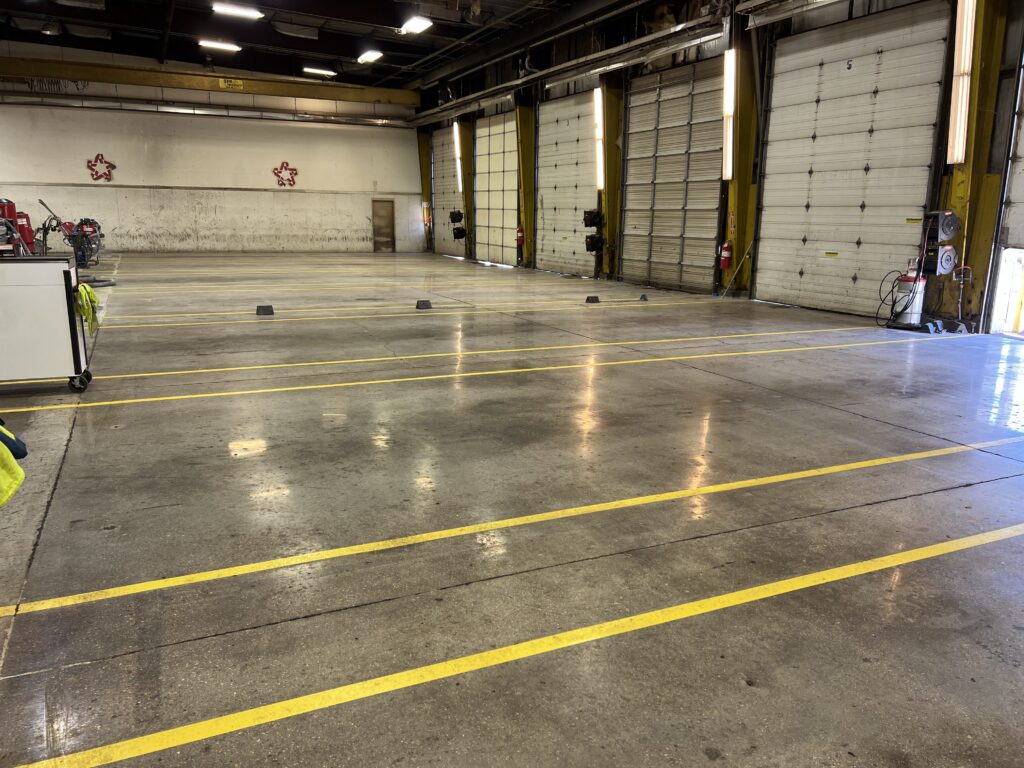
Polished concrete or epoxy comes down to what hits the floor. Polishing grinds and densifies the concrete you already have. Epoxy is a coating that goes on top of it. Since 2009, Colorado Concrete Repair has worked on commercial and industrial floors in Denver, and our quotes include both polished concrete and epoxy. We don’t do house floors, garages or basements. Pole barns are the one exception.
Find the Right Floor for How You Operate
Answer a few questions about your floor and the tool ranks four systems. Drag any slider to change the weights. It’s a starting point, not a final pick. Give us a call and we’ll set up a time to look at the floor.
Polished Concrete vs Epoxy vs Urethane Cement vs Broadcast Systems
No one system wins all the rows. Read the rows that match your floor. A named product’s chemical, heat and cure ratings come from its maker’s data sheet, so the cells below give what our quotes list.
| Attribute | Polished Concrete | Epoxy (100% Solids) | Urethane Cement | Quartz / Flake Broadcast |
|---|---|---|---|---|
| Chemical resistance | Our polish quotes finish with a penetrating protector for stain and chemical resistance | Novolac epoxy is in our scope where chemicals call for it; the maker’s sheet gives the rating | Rated by product on the maker’s data sheet | Set by the epoxy or urethane binder’s data sheet |
| Washdown & sanitation | For wet rooms our quotes switch to urethane cement | A food plant buyer guessed that cleaning chemicals and water weakened a failing epoxy bond | What our quotes use for wet and hot rooms | Our coating quotes can add a cove at the wall base |
| Forklift & impact traffic | Joints get flexible polyurea filler, shaved flush, where the scope includes them | One shop owner wrote that forklifts aren’t friendly to epoxy unless they’re small with white tires | One of our quotes lists 1/4 in BioCem with a sand broadcast and a heavy-duty topcoat | Our epoxy slurry quotes add a urethane topcoat with aluminum oxide grit |
| Return to service | The densifier and protector need cure time; night or phased work when quoted | Each coat cures on its product’s schedule and the site conditions | The maker’s sheet sets foot, vehicle and chemical service times | Several coats, phased by area when the plan calls for it |
| Wet slip resistance | We put no slip rating on a polished floor, and none of our polish quotes names a slip treatment | Aluminum oxide grit in a urethane topcoat, in our epoxy slurry quotes | Sand broadcast into the body coat in our quotes | Traction additive in the topcoat can be added or left out, as our quotes allow |
| Appearance | Concrete look, honed and polished up to 800 grit; patches aren’t expected to match | A coating that covers the concrete | Function first, with texture where sand is broadcast | Decorative flake in our quotes for labs, hallways and locker rooms |
| Where our quotes use it | Service floors and oily shop floors | ESD and novolac systems, where static or chemicals set the floor | Wet and hot process rooms | Clean rooms, labs, hallways and locker rooms |
Since 2009
Denver-based, working on commercial and industrial floors.
More Than 1,000 Jobs
Counted across the whole company.
Polish, Epoxy, Urethane
All three show up in our quotes, along with grind and seal.
Polished Concrete or Epoxy: What Decides It
Open a topic to see what our quotes list for each floor and where each one falls short.
When Polished Concrete or Epoxy Is the Right SpecificationApplication criteria▼
Best for: Commercial and industrial facilities where polished concrete vs epoxy flooring addresses specific substrate, chemical, or operational requirements. CCR evaluates each facility’s conditions during the preconstruction site assessment.
✓ Strengths:
- Matched to your facility’s specific chemical exposure, traffic, and environmental conditions
- Seamless, non-porous finish that simplifies cleaning and maintenance
- Engineered to handle the mechanical loads your facility generates daily
Tradeoffs:
- System selection depends on substrate condition — testing required before specification
- Not every system fits every environment — wrong product selection causes premature failure
- Professional installation required — this is not a DIY or general-contractor operation
Common applications: commercial and industrial facilities — see our polished concrete services page.
Polished Concrete Finish LevelsMatte to high-gloss▼
Best for: The level of polish determines both the aesthetic and the performance characteristics. Higher polish levels increase reflectivity and stain resistance but require more processing steps.
✓ Strengths:
- Multiple finish levels from 400-grit matte to 3000-grit high-gloss mirror finish
- Densifier and hardener treatment increases surface durability at every level
- Light-reflective finishes reduce lighting costs in large facilities
- No topical coatings to peel or delaminate — the finish is in the concrete itself
Tradeoffs:
- Higher gloss levels require more processing passes and cost proportionally more
- Polished concrete is not a coating — it requires sound, quality concrete substrate
Common applications: retail, office, warehouse, institutional — see our polished concrete services.
Prep Before Polish or EpoxyGrinding, joints, moisture▼
Best for: Our epoxy quotes grind and/or media blast the concrete to a CSP of 2 or greater. Our polish quotes start with 30 grit metal diamonds to take off surface stains. The quotes list HEPA vacuums on that equipment.
✓ Strengths:
- Cracks, spalls and joints are prepped, filled and ground flush where the quote lists patchwork
- Construction joints can be honored rather than filled
- Where one of our quotes noted high humidity in the concrete, it added a moisture vapor barrier primer
- Old epoxy can come off with PCD or 18 grit diamonds before a floor is polished
Tradeoffs:
- For coatings, our standard terms assume moisture under 3 lbs per 1,000 sq ft or under 75% RH; above those limits, the primer may need to be replaced with a mitigation system, as a change order
- Each patch and coat cures on the product’s own schedule, which shifts with conditions
- Shot blasting only reaches where the machine can get access
Common applications: all commercial flooring projects — see our installation process.
Working Around Your OperationPhases and off-hours▼
Best for: Facilities that can’t close the whole floor at once. Access, phasing and off-hours work can be part of the quoted plan. A service floor quote of ours, with old epoxy coming off and polish going down, included 2 phases.
✓ Strengths:
- Work split by area when the plan calls for phases
- Night work priced on its own in one refresh quote, with a day-work option
- Cure times taken from the data sheet of each product we put down
- Our quotes ask that obstacles and obstructions be cleared before we mobilize
Tradeoffs:
- Phased installation may extend total project timeline compared to full-facility shutdown
- Each phase needs its access agreed with your team
- A coating can’t take traffic until it cures; the maker’s sheet sets foot and vehicle times
Common applications: all CCR flooring projects — request a site assessment.
POLISHED CONCRETE VS EPOXY FLOORING QUESTIONS
Frequently Asked Questions
What should I know before choosing between polished concrete and epoxy?
Start with what hits the floor. Forklifts, oil, chemicals, hot water and how you clean all change the answer. Then look at the concrete: cracks, joints, old patches and oil. Polish leaves patches visible. Epoxy covers them, but it has to bond. For wet and hot rooms, our quotes use urethane cement instead.
How does surface preparation affect polished concrete and epoxy floors?
Our epoxy quotes grind and/or media blast the concrete to a CSP of 2 or greater. Where the scope includes patchwork, cracks and joints get a thickened epoxy patch ground flush, unless joints are to be honored as construction joints. Our polish quotes start with 30 grit metal diamonds and hone up to 200 grit before the densifier.
How long do polished concrete and epoxy floors last in a commercial environment?
We don’t give a year count for either. Traffic, chemicals, cleaning and the product change the answer, and the maker’s data sheet holds the ratings. They wear differently. A dull polished floor can be honed and polished again. A worn coating can mean a substantial recoat, not a quick touchup.
Can this work be done while our facility stays operational?
It depends on the floor and the plan. Access, phasing and off-hours work can be part of a quoted plan. One refresh quote of ours priced night work, with a day-work option. A coating needs its cure time before traffic, so a phase stays closed until the product’s data sheet says it’s ready.
How do I choose the right contractor for polished concrete or epoxy work?
Ask what the quote lists: the grinding steps, the patch and joint work, each product by name and what’s excluded. Ask whether they quote both polish and coatings, so the answer fits your floor. We quote polished concrete, epoxy and urethane cement. Ask for references from facilities like yours.
Request a Site Assessment
Polish or epoxy, your floor decides. Give us a call and we’ll set up a time to look at it.