
Polyaspartic Flooring Denver — UV-Stable, Fast-Cure Systems for Industrial Concrete
Aliphatic topcoat systems for industrial facilities requiring same-day return to service and long-term UV stability.
Walkable in 1–6 Hours
Polyaspartic reaches handling strength same day. Standard epoxy needs 12–24 hrs. For facilities that cannot hold shifts, this changes the scheduling equation.
UV-Stable for Life
Aliphatic chemistry means no yellowing, chalking, or hazing under UV. Standard aromatic epoxy turns amber in months. Polyaspartic holds gloss and color for years.
−30°F to +140°F Application Range
Install in extreme conditions without compromising adhesion or cure chemistry. Epoxy becomes brittle below 50°F at application.
Ask Us About Polyaspartic Flooring
What is polyaspartic flooring?
Polyaspartic is an aliphatic polyurea-based topcoat that cures 4–10× faster than standard epoxy and delivers superior UV stability. It is not a standalone system — the professional standard is a hybrid: epoxy primer and base coat with polyaspartic as the finish layer.
Is polyaspartic stronger than epoxy?
They have different strengths. Epoxy wins on adhesion and moisture vapor management. Polyaspartic wins on UV stability and cure speed. The professional standard is a hybrid system — not either/or. Choosing one over the other as a standalone depends on the specific substrate and performance requirements.
Can polyaspartic be applied over high-moisture concrete?
No. All manufacturer TDS data requires moisture vapor emission rates at or below 3 lbs/1,000 sf/24 hrs. Above that threshold, an epoxy moisture vapor barrier primer must be installed first. (Sources: LATICRETE Spartacote, Dur-A-Flex, Resinwerks product TDS data.)
What does a complete polyaspartic system look like?
Diamond grind to CSP 2–3 → ASTM F1869/F2170 moisture test → epoxy MVB primer if MVRE exceeds 3 lbs → epoxy base coat → aggregate broadcast → polyaspartic topcoat. Each step is required. Skipping moisture testing is the most common cause of delamination failures.
How long does polyaspartic last?
10–15 years in standard industrial use with proper maintenance. Longevity depends on traffic load, chemical exposure, and substrate condition at installation. UV stability means color and gloss hold significantly longer than aromatic epoxy under the same conditions.
What does polyaspartic flooring cost in Denver?
$3–7/sf installed, depending on substrate condition, system build, and aggregate selection. Pricing reflects the complete hybrid system — not just the topcoat. Sites requiring moisture vapor barrier primers, significant surface repair, or multiple broadcast layers will fall toward the high end.
What are polyaspartic’s weaknesses?
Not moisture-independent — requires epoxy primer on high-MVRE slabs. Shorter pot life than epoxy, which can work against large pours in extreme heat. Higher cost per square foot than standard epoxy. Not the right choice when the primary requirement is moisture vapor management — that is an epoxy strength.
Where does polyaspartic outperform epoxy?
Facilities with UV exposure (skylights, sun-lit production areas), exterior concrete, operations that need same-day return to service, and installations in cold environments where application temperature drops below 50°F — epoxy becomes brittle at those temperatures while polyaspartic maintains cure performance down to −30°F.
Polyaspartic vs. Standard Epoxy
Key performance differences across six criteria. In most industrial applications, both systems are used together.
| Criteria | Polyaspartic | Standard Epoxy |
|---|---|---|
| Cure Time | 1–6 hours — same-day return to service | 12–24 hours minimum |
| UV Stability | Excellent — aliphatic chemistry, no yellowing | Poor — aromatic epoxy yellows under UV |
| Moisture Tolerance | Low — requires MVRE ≤3 lbs (or epoxy MVB primer) | High — MVB epoxy handles up to 25 lbs MVRE |
| Adhesion | Good as topcoat over prepared epoxy base | Excellent — 100% solids bonding to concrete |
| Ideal Role | UV-stable finish topcoat | Foundation layer and moisture vapor barrier |
| Cost/SF Installed | $3–7 | $2–5 standard; $4–9 specialty |
Professional Installation Process
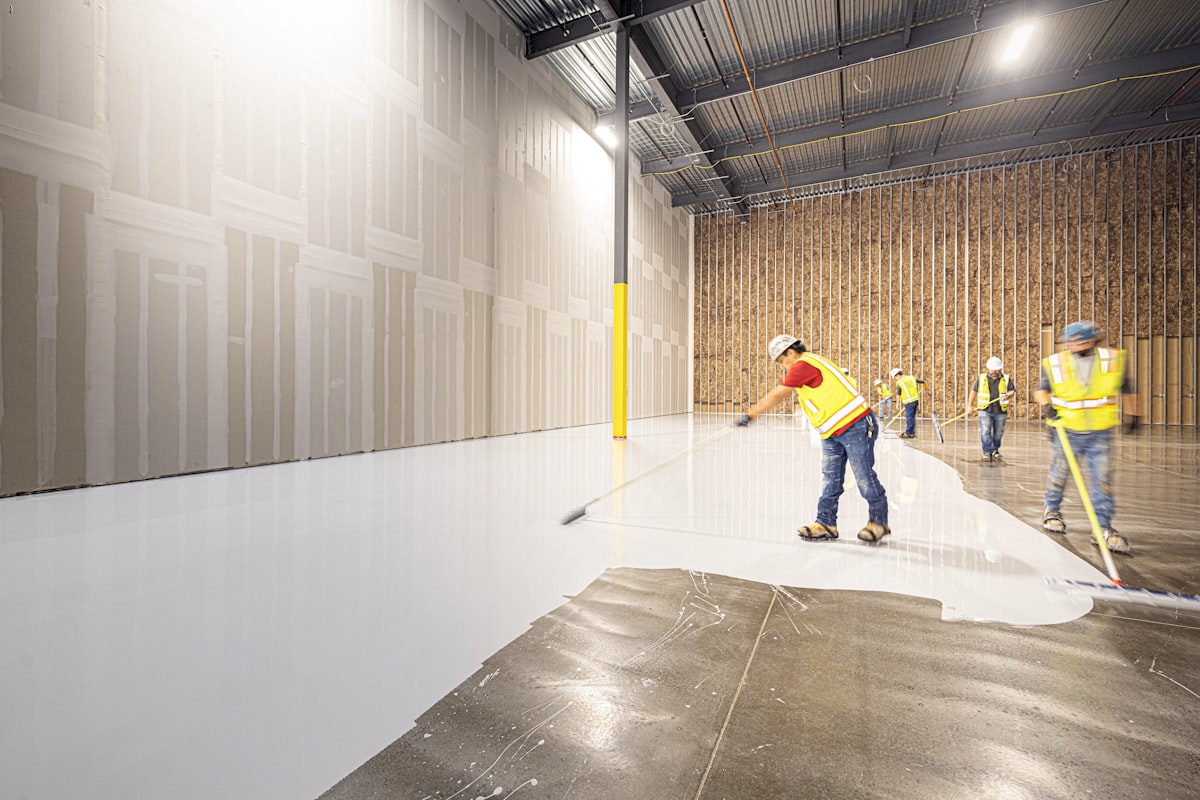
How Our Urethane Cement Installation Process Works
We review site conditions with your team, discuss schedule and operating constraints, and compare suitable system options. The goal is to align scope, phasing, and expectations before work begins.
After scope approval, we execute the selected system and prep approach for the area and use case. Work is sequenced to match operational needs and project constraints defined during planning.
We complete a final walkthrough with your team, confirm installed scope, and share practical care guidance. Any remaining punch-list items are documented and closed through the agreed handoff process.
More Questions About Polyaspartic Flooring
How thick is a polyaspartic system?
A complete hybrid system runs 20–30 mils total. The polyaspartic topcoat alone is 4–8 mils. Build thickness is determined by substrate condition, traffic load, and aggregate selection.
Can polyaspartic be used as a standalone system?
Not recommended on high-MVRE slabs. Polyaspartic is engineered as a topcoat — the industry standard is hybrid: epoxy MVB primer plus epoxy base coat plus polyaspartic topcoat. Standalone polyaspartic over unprepared or high-moisture concrete is a common failure pattern.
What surface prep does polyaspartic require?
CSP 2–3 minimum per ICRI standards, achieved via diamond grinding. Concrete must be structurally sound and free of contamination. ASTM F1869 or F2170 moisture testing is required before any coating application.
Can polyaspartic be applied in cold temperatures?
Yes — most polyaspartic systems maintain application performance down to −30°F, compared to standard epoxy which becomes brittle below 50°F. Confirm with the specific product TDS, as pot life and cure time vary by formulation and ambient temperature.
What colors are available?
Virtually unlimited. Aggregate, pigment, and topcoat variables allow custom color matching for safety marking, branding, or zone delineation. Standard broadcast aggregates (quartz, flake, mica) are available in dozens of color combinations.
Is polyaspartic VOC-compliant?
Yes. Most commercial polyaspartic systems are low or zero VOC. Confirm with the specific product TDS for local air quality compliance requirements, particularly for enclosed facilities with limited ventilation.
Why Colorado Concrete Repair
Colorado Concrete Repair is a locally owned industrial flooring contractor serving the Denver metro area. Our certified installers bring decades of combined experience to every project — engineered flooring systems built to your facility’s exact operational requirements.
- Locally owned and operated in Denver CO since 2009
- Certified installers — not a pop-up franchise
- Validated installation protocols for every substrate type
- Preconstruction consultation on every project
- Scope locked at approval — no change orders after sign-off
- Engineered flooring systems for industrial and commercial facilities
- Work sequenced around your facility’s operational schedule
- Single point of contact from site assessment through final walkthrough
OR, TELL US ABOUT YOUR PROJECT: