
Concrete Repair vs Replacement: How Commercial Owners Decide
Concrete Floor Repair or Replacement: How Commercial Owners Decide
Colorado Concrete Repair does partial-depth repair on commercial and industrial floors in the Denver metro. This guide shows how concrete repair services handle cracks, spalls, broken joints and voids, and when a floor needs replacement instead. We don’t replace slabs, and we don’t work on garages, basements, driveways or foundations.

Since 2009
Commercial and industrial floor repair from our Denver base.
More Than 1,000 Jobs
Company-wide. The repair quotes we reviewed list steps for the damage in each scope.
Under 2 Inches Deep
Partial-depth work: spalls, patches and grinding. We don’t replace panels.
Concrete Floor Repair Methods, and Where Repair Stops
Open a method to see the damage it fits, what our quotes list and when the floor needs replacement instead.
Cracks in the FloorCrack injection▼
Fits: Cracks in commercial and industrial floors. Our crack injection quotes fill the crack with a low-viscosity epoxy, injected under pressure, port to port.
✓ What our quotes list:
- Inspect, mark and clean each crack
- Set injection ports and seal the crack face with epoxy paste
- Inject epoxy port to port until the crack is filled
- Remove the ports and grind the seal flush
Where repair stops:
- We don’t do structural engineering. A crack that needs an engineer’s design is outside our work
- The resin cures on the schedule its maker’s spec sets
- Walls and foundations are outside our work
Where it’s used: interior commercial and industrial floors. See our concrete repair services.
Spalls and Broken AreasCut out and patch▼
Fits: Areas where the top of the floor is chipped, broken or crushed, with sound concrete below. Our quotes mark each area by sounding the floor with chains or hammers.
✓ What our quotes list:
- Cut around each area with diamond blades on HEPA vacuums
- Remove the unsound concrete with chipping hammers
- Patch with Metzger/McGuire Armor-Hard repair epoxy
- Grind along the patch where needed so forklifts pass over smoothly
Where repair stops:
- A cementitious patch is not expected to match the color of the floor around it
- We don’t replace panels. For damage through the slab, have a form-and-pour contractor assess it
- Each patch material cures on its maker’s schedule
Where it’s used: forklift aisles and work areas in plants and warehouses. See our repair process.
Voids and Uneven FloorsFill and grind▼
Fits: Slabs that rock or deflect over voids, and floors with high spots. Our quotes fill the voids with foam and grind the high spots. They don’t lift slabs.
✓ What our quotes list:
- A 2-component stabilizer foam injected through drilled holes
- Foam that expands into the voids and becomes rigid
- Metzger/McGuire Spal-Pro Stabilizer EXP Foam
- Floor flatness grinding, checked with 8-foot levels
Where repair stops:
- We don’t raise sunken slabs back to grade
- Broken or failed slabs go to a form-and-pour concrete contractor
- Foam and leveler cure on their makers’ schedules
Where it’s used: joints that move under forklifts, and floors going under a new finish. See concrete repair options.
Joint Repair & RebuildBroken joint edges▼
Fits: Joints whose edges chip and break under forklift traffic. Buyers point to steel and hard rubber wheels as the cause.
✓ What our quotes list:
- Demo and clean the joint with a joint saw on a HEPA vacuum
- Patch broken edges with Armor-Hard repair epoxy
- Fill with flexible polyurea joint filler and shave it flush
- Grind the high side of a joint for a smooth pass-over
Where repair stops:
- Metzger/McGuire notes there are no government or ASTM standards for semi-rigid joint fillers
- On new slabs, its sheets say MM-80 should not go in before 30 days, and Edge-Pro 90 needs 28 days minimum
- For slabs that rock under forklifts, the voids get stabilizer foam
Where it’s used: warehouse and manufacturing floors. See commercial joint repair with Metzger/McGuire materials.
CONCRETE REPAIR QUESTIONS
Questions About Repairing or Replacing a Concrete Floor
How do I know if my concrete floor needs repair?
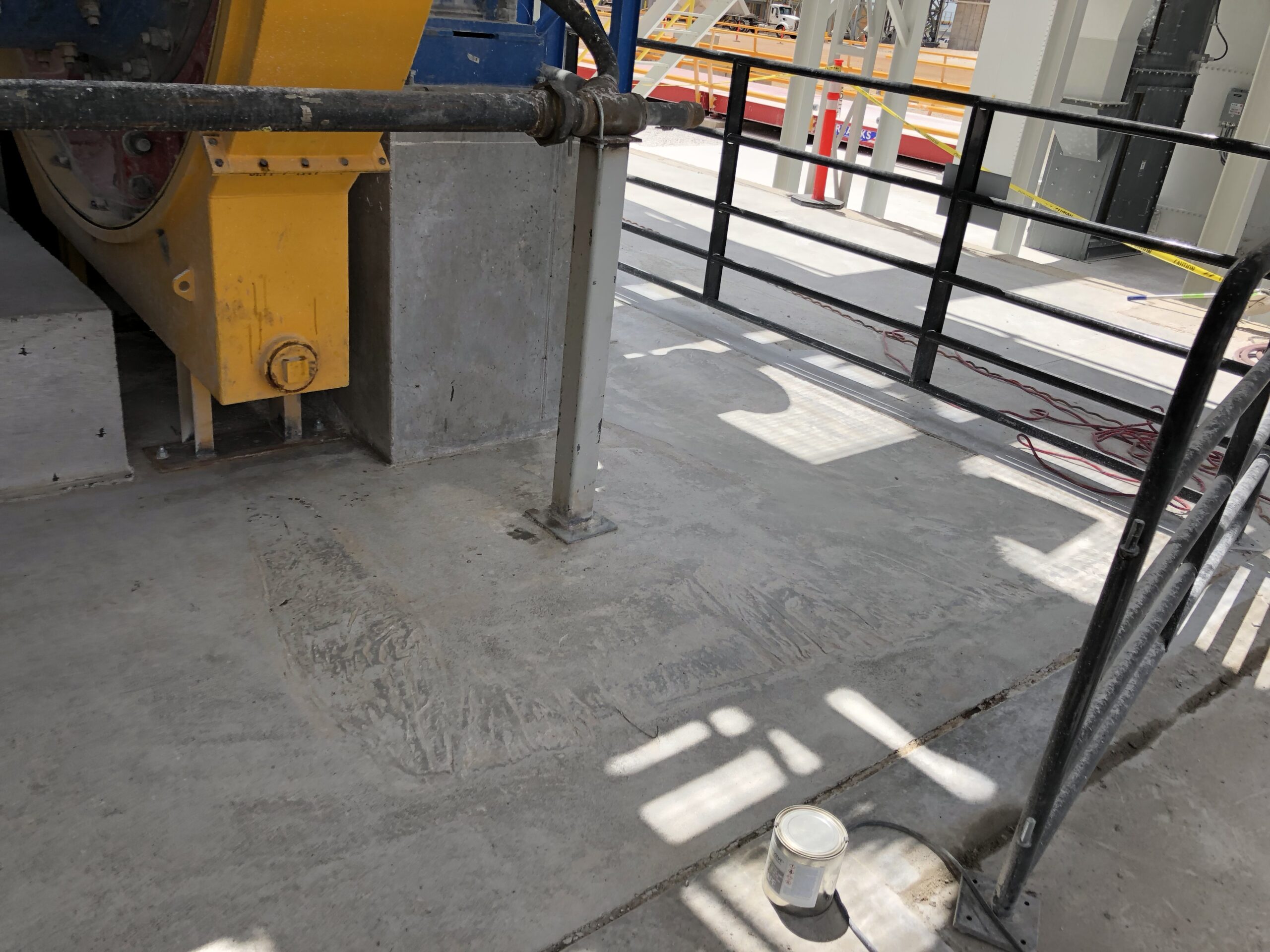
Look for cracks, chipped or broken joint edges, and spalled or crushed areas. Look for peeling or flaking coatings, and slabs that rock or bump when forklifts cross. Our quotes sound the floor with chains or hammers to mark where damage stops. Damage through the slab is past our partial-depth work, so have a form-and-pour contractor assess it.
Can concrete be repaired without full replacement?
Yes, when the concrete below the damage is sound. We do partial-depth work: patches, spall repair, joint repair, crack injection and grinding, generally under 2 inches deep. We don’t replace panels. A slab that is broken through or failing from below goes to a form-and-pour concrete contractor.
How long does concrete repair take?
It depends on the scope and the materials. Some of our repair quotes are priced by the day as time and materials. Phasing by area and off-hours work can be part of a quoted plan. Each patch, filler or resin cures on the schedule its maker’s data sheet sets.
What causes concrete floor deterioration?
Buyers point to forklift wheels breaking joint edges, especially steel and hard rubber wheels. Our quotes also find crushed areas, cracks and voids under slabs that let them rock. On coated floors, cleaning chemicals and water can weaken the bond. The repair follows the damage, so the steps change from area to area.
Should I repair or replace my concrete floor?
It depends on how deep the damage goes. Our work is partial-depth repair, generally under 2 inches deep, plus coatings and polishing. We don’t replace panels. If the damage runs deeper or the slab has failed, have a form-and-pour concrete contractor assess it. Give us a call and we’ll look at the damaged areas.
Have Us Look at the Damage
Give us a call and we’ll set up a time to walk the damaged areas with you.