
Epoxy Floor Surface Preparation Methods: Why Prep Determines Performance
Epoxy Floor Surface Preparation for Commercial and Industrial Floors
Colorado Concrete Repair’s surface preparation process is the first numbered step in many of our coating quotes. This guide covers what those quotes list for prep, the surface profile they call for, and how old coatings and moisture change the plan. It’s for commercial and industrial floors in the Denver metro, not garages or basements.
Since 2009
Commercial and industrial floor prep and coatings from our Denver base.
More Than 1,000 Jobs
Company-wide. Our coating quotes list prep steps such as grinding and patching.
CSP 2 or Greater
The surface profile many of our coating quotes call for, by grinding or blasting.
How a Commercial Floor Gets Ready for Epoxy
Open a step to see what our quotes list for it and where it stops.
Grinding and Shot BlastingOpen the concrete▼
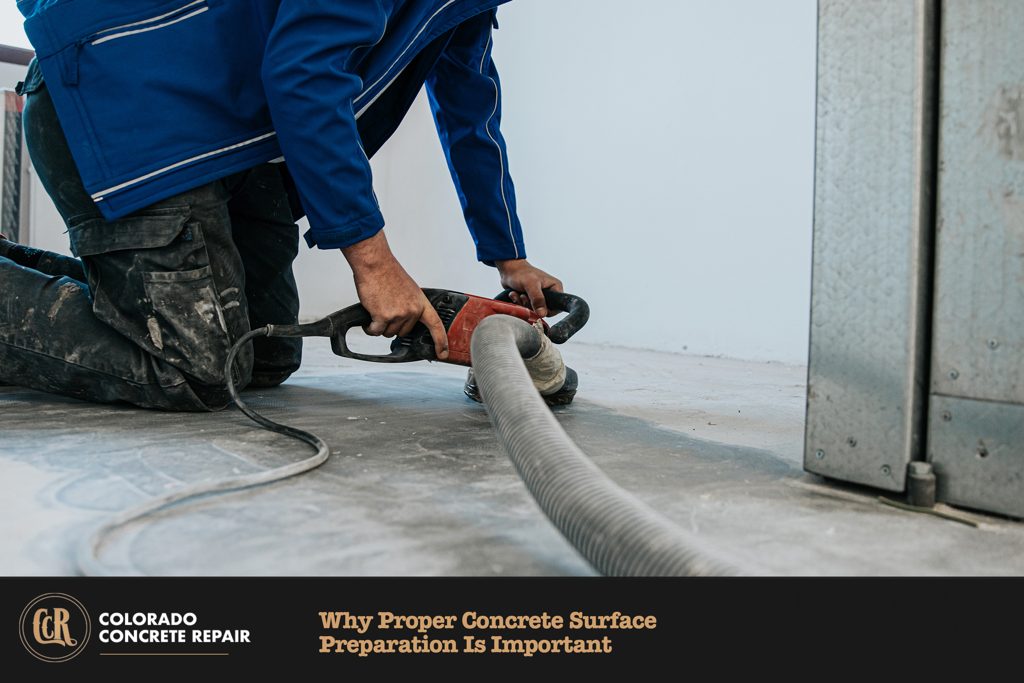
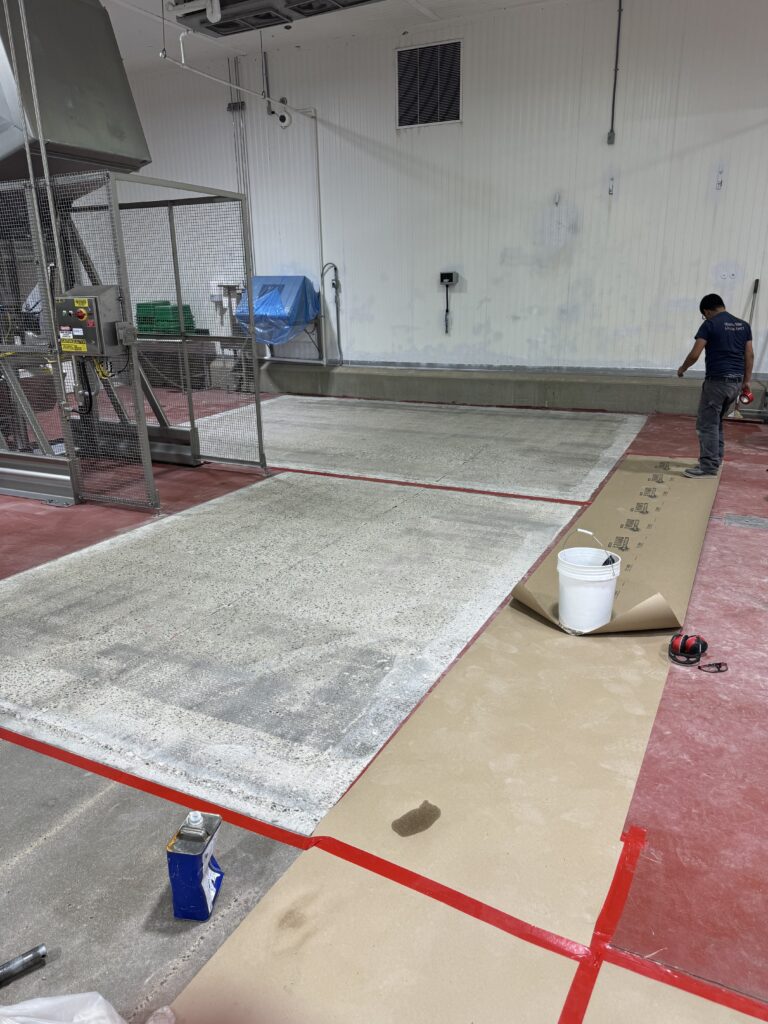
What it does: Grinding or blasting takes off the top layer and opens the pores of the concrete so the coating can soak in. Our coating quotes call for a concrete surface profile of CSP 2 or greater.
✓ What our quotes list:
- Diamond grinding that starts with 30-grit tooling and finishes with 80-grit
- Grinding with 18 grit diamonds in a crosshatch pattern, where access permits
- Hand grinders and planetary walk-behind grinders on HEPA vacuums
- Shot blasting or media blasting in some scopes
Where it stops:
- Shot blasting only goes where the machine can safely reach
- Grinders and blasters run on HEPA vacuums to collect the dust
- Each product goes down per its maker’s instructions
Where it’s used: plant, warehouse and lab floors getting epoxy or urethane. See our surface preparation methods page.
Old Coatings, Cracks and JointsRemove and repair▼
What it does: Old coating comes off and damage gets filled before the new coating goes down. Our quotes remove existing epoxy with PCD diamond tooling on grinders tied to HEPA vacuums.
✓ What our quotes list:
- Holes, joints and cracks prepped for a thickened epoxy patch, finished flush
- Patches with thickened Vapor Barrier Epoxy where the floor needs it
- Grinding flush where cracks, spalls and joints occur, unless construction joints are to be honored
- Vacuuming several times with HEPA vacuums, and an acetone wipe where the system calls for it
Where it stops:
- Changing part of a coated floor usually means a recoat, not a touchup
- Our repair work is partial depth. Slab replacement is outside our work
- Patch and coating cure times come from each product’s data sheet
Where it’s used: floors with a failing coating, cracks or broken joints. See our installation process.
Moisture and New ConcreteKnow it before you coat▼
What it covers: Moisture in the slab can stop an epoxy job. One buyer reported a new slab reading 89 to 94 percent RH against a 72 percent spec. Our standard terms price a slab under 75 percent RH or 3 lbs per 1,000 sq ft.
✓ What our quotes list:
- A moisture vapor barrier primer, in the systems that call for one
- Resinwerks Vapor Barrier Epoxy primer with a quartz broadcast, in some scopes
- If moisture exceeds those limits, the primer may need to be replaced with a moisture mitigation system by change order
- Phased areas and off-hours shifts when the plan calls for them
Where it stops:
- We don’t moisture test every floor. Your quote states what it includes
- Cure time depends on the product and site conditions
- Coating new concrete waits on the product maker’s instructions
Where it shows up: new slabs and floors with damp areas. To have us look, request a site assessment.
EPOXY FLOOR PREP QUESTIONS
Frequently Asked Questions
What surface preparation is needed before applying epoxy?
The concrete needs to be clean, porous and repaired. Our epoxy quotes list steps such as grinding or blasting on HEPA vacuums to a CSP of 2 or greater, patching cracks, spalls and joints where the floor needs it, and vacuuming several times before the primer. The product maker’s instructions set the rest.
How does surface preparation affect epoxy floor performance?
Prep is what the coating holds onto. Buyers with failing epoxy describe peeling, chipping and a bond weakened by cleaning chemicals and water. Our coating quotes grind or blast to a CSP of 2 or greater and fill damage before the coating goes down, so it goes onto sound, clean concrete.
What is concrete surface profile (CSP)?
It’s how rough the prepared concrete is. ICRI publishes 10 reference profiles. KTA lists CSP 1 as acid-etched, CSP 2 as grinding and CSP 3 as a light shot blast. Many of our coating quotes call for CSP 2 or greater. One quote for a mortar berm calls for a CSP of 3 or greater.
Can this work be done while our facility stays operational?
It can be planned around your operation. Phasing by area and off-hours work can be part of a quoted plan. The grinders and blasters run on HEPA vacuums. The coating’s data sheet sets when foot traffic, vehicles and chemicals can return, based on the product and site conditions.
Who prepares industrial concrete floors before coating?
We do, as part of our coating scopes on commercial and industrial floors in the Denver metro. Our quotes include the prep: grinding or shot blasting, removing old coatings, patching, then the primer and coats. Whoever you hire, ask what CSP they will reach and how they will handle old coatings and moisture.
Planning a Coating on Your Floor
Give us a call and we’ll set up a time to look at the concrete before anything gets coated.